
We earn a commission if you buy through these links. Learn more
Lean thinking
Guide by the Books of the Day editors · Updated · How we write our guides
A short, persuasive introduction to lean thinking's five principles, showing how the logic behind Toyota's production methods applies to nearly any organization that delivers value to customers.
What Creators Say About Lean thinking
2 creators reviewed Lean thinking on YouTube between 2018 and 2022, with 164.5K views between them. Their opinions are their own; we picked these reviews, we didn't write them.
What It's About
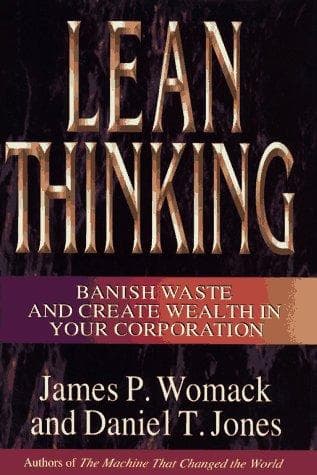
Lean Thinking, written by James P. Womack with Daniel T. Jones, takes the lessons of Toyota's production methods and turns them into a general framework for any organization that makes things or delivers services. Its central claim is that companies waste enormous effort on activities that do nothing for the customer, and that a few clear principles can expose that waste and redirect effort toward what people actually pay for.
The approach is more practical than theoretical. The authors move through a set of principles, illustrating each with case material from manufacturing and other industries, and they spend real time on the managerial habits that make the principles stick, not just on the tools. The tone is confident and argumentative, so the book reads as a case being made rather than a neutral survey.
Reading it feels like sitting through a long, well-organized argument for changing how you think about work. It rewards readers who manage processes, lead teams, or simply want to understand why some operations feel smooth and others feel clogged. Expect less step-by-step instruction than a workbook and more of a worldview, one you will need to test against your own situation.
Read this if you…
- Want a clear framework for finding waste in any process, not just in factories.
- Manage operations or teams that feel slow and want a structured way to diagnose why.
- Are curious about where lean methods came from and how they spread beyond Toyota.
Skip it if you…
- Want a hands-on how-to guide with templates, checklists, and step-by-step tools.
- Are looking for a critical or contrarian view of lean management.
Key Ideas
- 1
Value is defined by the customer
The book starts from the idea that value can only be judged from the buyer's side. Many internal activities feel productive to the people doing them but add nothing the customer would willingly pay for. Lean thinking asks you to state, precisely, what the customer wants and to treat everything else as a cost to justify.
- 2
Map the whole stream to find waste
Instead of optimizing single departments, the authors encourage you to trace the full sequence of steps that turns a request into a delivered product or service. Looking at the entire chain reveals handoffs, rework, and waiting that local managers rarely see, and it shifts attention to the path rather than to any one station.
- 3
Make work flow without interruption
A central theme is that batching and queuing hide problems and slow delivery. The book argues for arranging work so items move continuously from one step to the next. Smoother flow shortens the time between effort and result, which makes errors visible sooner and reduces the cost of holding inventory or unfinished work.
- 4
Pull work on demand, then pursue perfection
Pull means producing only when a downstream need appears, rather than pushing output forward on forecasts. The authors pair this with a commitment to continual improvement, treating perfection as a direction to keep moving toward rather than a finished state. The idea is less about any single technique than about a habit of ongoing refinement.
Limitations
Written in the mid-1990s, the book's examples and figures reflect that period, and some of its manufacturing detail will feel dated. Critics argue that the lean label has since been applied in ways the authors did not endorse, such as cost-cutting drives that squeeze staff without improving flow. The book is also more persuasive than it is cautious about tradeoffs, and it says relatively little about managing the human side of change or about where lean fits poorly in creative or highly variable work.
Questions Readers Ask
- Is Lean Thinking still relevant outside factories?
- Yes, that is much of its lasting value. The principles are framed to apply to any work that moves through steps to reach a customer, and the book makes a case for service and office settings. Treat the specific examples as illustrations and focus on the logic about waste and flow, which transfers well to software teams and administrative work.
- How does it compare with The Toyota Way?
- The Toyota Way by Jeffrey Liker focuses more on the Toyota company itself, including its culture, people development, and management systems. Lean Thinking is broader and more portable, aiming to give a general framework for any organization. If you want the principles, start with Womack and Jones; if you want the deeper culture behind them, read Liker next.
- Do I need to read The Machine That Changed the World first?
- No. The Machine That Changed the World, written with Daniel Roos, covers the history of lean production and the wider auto industry. Lean Thinking is written to stand on its own and moves from history to principles. Reading the earlier book first adds useful context but is not required.
- Published
- 1996
- ISBN
- 9780684810355
- Difficulty
- beginner
- Category
- Productivity
Book details and cover from Google Books.
Ready to read Lean thinking?
Get your copy on Amazon, or listen to it on Audible. We earn a commission if you buy through these links.