
We earn a commission if you buy through these links. Learn more
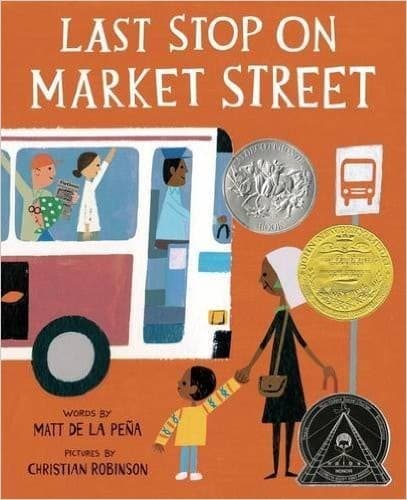
Last Stop on Market Street
by Matt de la Peña, Christian Robinson
A warm, unhurried picture book that turns a routine Sunday bus ride into a gentle lesson in gratitude, seeing your own life clearly, and the value of paying attention to the people around you.
What It's About
Last Stop on Market Street follows CJ, a boy who rides the city bus across town every Sunday with his grandmother, whom he calls Nana. The trip is ordinary, and CJ isn't happy about it. He wants to know why his friends have cars and why he has to wait in the rain, and he's curious about the stops they make along the way. Nana answers him with questions of her own, and the book's quiet argument unfolds through what he begins to notice.
The text is spare and mostly dialogue, so it reads aloud in about ten minutes and has a call-and-response rhythm that works well with small children. Christian Robinson's collage illustrations carry much of the emotional weight. The bus is crowded with people of many ages and backgrounds, and the bright, textured pages make the city feel lively instead of grim. The city itself is never named, which lets the scenes stand for any busy urban neighborhood.
Reading it as an adult is a different experience. It is a short, tender book about perspective and about how a child learns to find meaning in what he already has. It rewards a slow second read, when the small details of the illustrations start to matter as much as the words.
Read this if you…
- want a picture book that opens real conversations with young children about money, fairness, and gratitude
- appreciate art that does as much storytelling as the words do
- are a parent, teacher, or librarian looking for a quiet read-aloud with depth for adults too
Skip it if you…
- want a plot-driven story with conflict, rising stakes, or a surprise ending
- are looking for a frank, detailed portrait of poverty and the systems that cause it
Key Ideas
- 1
Reframing what seems like lack
CJ measures his life against his classmates' comforts, and his grandmother gently changes the question. The book doesn't deny the hardships of the trip. It suggests that the way you describe your circumstances shapes how you experience them, and it shows this through conversation rather than lecture.
- 2
Noticing the people around you
Much of the story happens in the bus itself, among riders who are working, singing, reading, or helping each other. The book trains a child's eye toward strangers and asks readers to see them as individuals with their own lives, which makes the ordinary trip feel full of possibility.
- 3
Collage as a way of seeing
Robinson's layered, cut-paper style fills the pages with texture and color, and its warmth shapes how the city looks. The art makes the everyday feel beautiful without pretending it is easy, which is part of the book's argument about where beauty can be found.
- 4
Intergenerational conversation as a model
The bond between CJ and Nana is the heart of the book. Her patience, her questions, and her willingness to let him reach his own conclusions show a style of adult guidance many readers will find instructive, and the book invites parents and teachers to talk with children in the same way.
Limitations
The book can feel didactic, and Nana's wisdom is sometimes delivered a little too neatly for readers who prefer subtlety. The story covers a single bus ride, so there is little narrative tension. Its portrayal of a low-income family is warm and dignified, but it stays gentle and doesn't examine the economic or structural causes behind the hardships it touches. Some readers see that restraint as a strength and others as a missed opportunity.
Questions Readers Ask
- What age is Last Stop on Market Street for?
- It is aimed at roughly ages three to seven and works well as a read-aloud. Older children and adults will notice more layers in the conversation and the artwork, and many teachers use it with elementary classes for discussion about community and perspective. The text is short enough that the same book can serve both very young listeners and older readers on a second reading.
- How does it compare to other picture books about everyday kindness?
- It is quieter and less sentimental than many books on the theme. Where some picture books rely on big emotional payoffs, this one builds its meaning through a few honest questions and a richly textured city. Readers who enjoy it often pair it with books that handle similar themes of community and belonging, though it stands apart for its artwork.
- Is it worth reading if I'm not a parent or teacher?
- Yes. The book is short, but its ideas about perspective and attention hold up for adults who want a quick, thoughtful read. Many readers come back to it because the illustrations reward slower looking, and the conversation between CJ and his grandmother gives a gentle reminder about how we talk to the young people in our lives.
- Published
- 2015
- ISBN
- 9788484705499
- Difficulty
- beginner
- Category
- Children's Books
Book details and cover from Google Books.
Ready to read Last Stop on Market Street?
Get your copy on Amazon, or listen to it on Audible. We earn a commission if you buy through these links.