
We earn a commission if you buy through these links. Learn more
Last Night at the Telegraph Club
by Malinda Lo
A tense, tender YA novel set in 1950s San Francisco, where a Chinese American teen's first romance unfolds in a hidden lesbian club while the Red Scare makes every secret more dangerous.
What It's About
Last Night at the Telegraph Club is a young adult historical novel set in San Francisco in 1954, when Chinatown lived under the shadow of anticommunist suspicion and gay bars could be raided at any time. The story follows Lily Hu, a seventeen-year-old Chinese American girl who is clever, careful, and expected to follow a respectable path. When she starts spending time at a lesbian club in North Beach, she begins to see how much of her life has been arranged around other people's fears.
Lo writes with a steady, observant voice and builds the book around the texture of its period: the unspoken rules of acceptable behavior, the danger of being named in the wrong place, and the way political suspicion seeps into ordinary family life. The pacing is deliberate. Much of the novel is about small risks and quiet choices rather than big set pieces, and the romance develops slowly enough that the reader feels the cost of each step.
Reading it is an immersive, emotionally weighty experience. It sits somewhere between a coming-of-age love story and a historical portrait, and it asks you to pay attention to what people could not say aloud. Expect a book that rewards patience and stays with you after the last page.
Read this if you…
- want a historical novel that treats 1950s queer history and Cold War paranoia with real specificity
- enjoy slow-building romance where the emotional stakes come from small, careful choices
- are interested in Chinese American experience told from inside a family and a neighborhood
Skip it if you…
- need fast plot momentum or a thriller-style pace
- want an adult-level literary novel with dense prose and layered narration
Key Ideas
- 1
Secrecy as a way of life
The characters constantly manage what others can see: their families, their jobs, their friendships, and their desires. Lo shows secrecy not as a dramatic plot device but as a daily discipline that shapes how people talk, dress, and decide who to trust. The tension comes from how normal this concealment feels to them and how much it still costs.
- 2
Politics that reach into private rooms
The Red Scare is not a background backdrop here. Suspicion of communists and of 'deviant' people overlaps, so that a bar, a friendship, or a family name can become evidence against someone. The novel makes clear how political paranoia targeted immigrants and queer people alike, and how the club functions as a fragile refuge.
- 3
Ambition pulling against belonging
Lily's intellectual drive and her hopes for a future beyond her family's expectations create a constant pull against the community she loves. The book takes seriously the question of what a bright young woman is allowed to want, and what it costs her to want it openly.
- 4
Chinese American life within a larger history
Lo portrays a Chinese American community with its own pressures around respectability, reputation, and assimilation, rather than treating it as a backdrop to the wider city. This gives the historical setting depth and makes the personal choices feel tied to family and neighborhood, not only to sexual identity.
Limitations
Some readers find the pacing slow, especially in the middle stretches, where the story lingers on atmosphere and emotional hesitation. The romance is restrained, which suits the period and the target audience but may feel muted to readers who want more intensity. Because it is written for young adults, the prose is accessible and the moral lessons are fairly clear, so adult readers looking for ambiguity or complex formal experiments may find it more earnest than challenging. It is also a novel that compresses a lot of history into a personal story, so readers wanting a full historical account should look elsewhere.
Questions Readers Ask
- Is Last Night at the Telegraph Club suitable for adults, or only teens?
- It is classified as young adult, but many adult readers enjoy it. The prose is clear and the pacing is gentle, so it works well as a fast, accessible read. Adults who want more formal complexity or moral ambiguity may find it more straightforward than they would like, but its historical detail and emotional honesty hold up well at any age.
- How historically grounded is the novel?
- Lo draws on the real conditions of 1950s San Francisco, including the Red Scare and the risks faced by queer people in bars during that era. The characters and the club are fictional, so the book is best read as a novel informed by history rather than a documentary account of it.
- What should I read next if I liked it?
- If you enjoyed its mix of queer history and period atmosphere, try Sarah Waters' Tipping the Velvet or Fingersmith for a more adult, Victorian-era take on similar themes. For another Malinda Lo novel with a historical and romantic focus, her Ash, a queer reimagining of the Cinderella story, is a good follow-up.
- Published
- 2021
- ISBN
- 9798855077919
- Difficulty
- beginner
- Category
- Children's Books
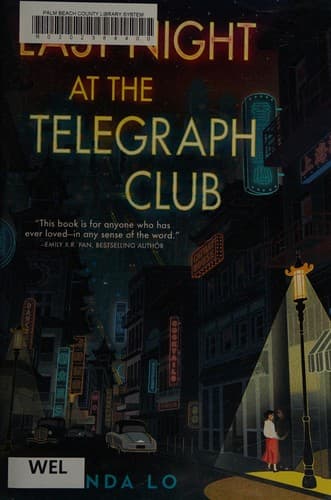
Book details and cover from Google Books.
Ready to read Last Night at the Telegraph Club?
Get your copy on Amazon, or listen to it on Audible. We earn a commission if you buy through these links.