
We earn a commission if you buy through these links. Learn more
Lagoon
Guide by the Books of the Day editors · Updated · How we write our guides
Nnedi Okorafor's Lagoon imagines first contact off Lagos, told through a marine biologist, a soldier and a rapper. Who will love it, and who should skip it?
What Creators Say About Lagoon
2 creators reviewed Lagoon on YouTube between 2014 and 2015, with 7.1K views between them. Their opinions are their own; we picked these reviews, we didn't write them.
What It's About
Lagoon begins with something arriving from the Atlantic into the waters off Lagos, Nigeria. Okorafor follows a small group of people pulled into what follows: Adaora, a marine biologist; Agu, a soldier; and Anthony Dey, a famous musician. Their paths cross in ways that expose the city's pressures, including corruption, crowded streets, religion, and the tension between tradition and modern life. The alien presence is the spark, but the book's real subject is how ordinary people respond when something enormous unsettles their sense of what is real.
The style is fast, layered, and urban. Chapters shift between viewpoints, and the prose moves easily between English and Nigerian Pidgin, with Igbo and Yoruba phrases woven through. Okorafor writes with a strong sense of sensory detail, from the water and the markets to the noise and heat of daily life, so Lagos feels present rather than like a backdrop.
Reading Lagoon is less like a tidy first-contact puzzle and more like stepping into a mood. It asks what a city does when its certainties give way, and who gets to be heard in that moment. Expect a book that is cinematic and sometimes messy, asking you to hold several threads at once and to trust that they will come together.
Read this if you…
- want speculative fiction rooted in a specific African city rather than a generic future
- enjoy ensemble novels that move between several viewpoints
- are curious about first-contact stories told outside the usual American or European perspective
Skip it if you…
- want a clear, linear plot with a tidy resolution
- prefer hard science and technical explanations of the alien and its biology
Key Ideas
- 1
Lagos as a living character
The city is not just a setting but a force that shapes every character's choices. Its crowds, economy, politics, and waterways drive the story, and the book treats urban life as something rich and complicated rather than exotic or merely dangerous.
- 2
First contact seen from the ground
Instead of focusing on governments or scientists in control, the novel looks at how everyday people react to the unknown. The fear, opportunism, curiosity, and improvisation of ordinary characters make the event feel immediate and socially real.
- 3
Competing responses: science, state, and faith
The characters draw on different frameworks to make sense of what is happening, including scientific observation, military authority, and spiritual belief. The book lets these worldviews collide without settling neatly on which one holds the answer.
- 4
Voice and multilingual texture
The mix of languages and speech patterns is central to how the book feels. Shifting voices give each character a distinct way of seeing the world, which makes the novel as much about identity and belonging as about the alien arrival.
Limitations
The shifting viewpoints and fragmented structure can make the plot feel scattered, especially in the first stretch, and some characters are sketched more lightly than others. The alien remains deliberately mysterious, which many readers find rewarding but others will see as frustratingly underexplained. The multilingual prose can also require patience from readers unfamiliar with Nigerian Pidgin or the cultural references. Those looking for a conventional, technically grounded first-contact novel will likely find it looser and more atmospheric than expected.
Questions Readers Ask
- Is Lagoon a good first Nnedi Okorafor book?
- It can be, though it is more sprawling and less conventional than some of her other work. Her novella Binti is shorter and more direct, which may suit readers who want an easier entry point. Lagoon rewards readers who are comfortable with multiple viewpoints and a looser, more atmospheric structure.
- How does Lagoon compare to Arrival?
- Both deal with first contact, but Arrival centers on language and a precise scientific puzzle. Lagoon is more concerned with social texture, with how a specific city and its people react. If you want the intellectual puzzle of Arrival, you may find Lagoon looser, but if you want a vivid human portrait, it offers more.
- Published
- 2014
- ISBN
- 9781444762785
- Difficulty
- intermediate
- Category
- Fiction
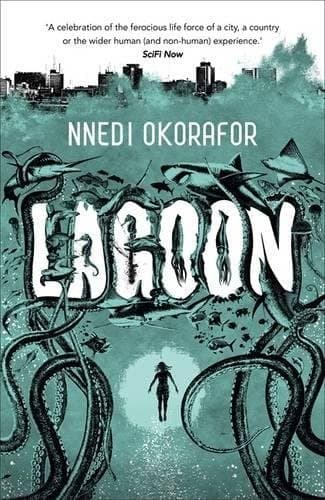
Book details and cover from Google Books.
Ready to read Lagoon?
Get your copy on Amazon, or listen to it on Audible. We earn a commission if you buy through these links.