
We earn a commission if you buy through these links. Learn more
Lab Girl
by Hope Jahren
Guide by the Books of the Day editors · Updated · How we write our guides
A candid, funny memoir from a working scientist that uses life in a plant lab to explore friendship, persistence, and living with depression.
What Creators Say About Lab Girl
2 creators reviewed Lab Girl on YouTube between 2016 and 2023, with 48.4K views between them. Their opinions are their own; we picked these reviews, we didn't write them.
What It's About
Lab Girl is Hope Jahren's memoir of a working life spent mostly in laboratories, where she studies how plants grow and what their fossil remains reveal about past climates. The book moves between her early years, her path into geobiology, and the everyday business of running research with a small team. Its real engine is her long working partnership and friendship with Bill Lane, the colleague with whom she built a lab from very little.
Her style is plain, funny, and often blunt. She explains enough science to make the work feel real, such as the patience required to measure tiny samples or wait out a growing season, without turning the pages into a textbook. Scenes of failed experiments, cramped equipment, and money worries sit alongside more personal material about depression and the exhaustion of academic life. The tone shifts often, so the book can feel more like a long conversation than a formal account.
Reading it is less like following an argument than spending time with a particular mind. Lab Girl works best as a portrait of a life in science and of friendship under pressure, with plants serving as a recurring image of patience, roots, and endurance. Expect short sections and a conversational voice, and don't expect a step-by-step guide to how research is done.
Read this if you…
- want a personal account of life inside a working research lab
- enjoy memoirs with a strong friendship at their core
- are interested in how science careers are sustained day to day
Skip it if you…
- want a clear, systematic explanation of plant biology or geology
- prefer memoirs that keep their emotional life largely offstage
Key Ideas
- 1
Science as daily, unglamorous practice
Much of the book shows research as repetitive, slow, and often frustrating work: careful measurements, failed attempts, and waiting on living things that do not follow a schedule. Jahren makes the labor visible, so readers come away with a realistic sense of what discovery looks like on an ordinary Tuesday rather than the dramatic breakthroughs that fill popular science writing.
- 2
Friendship as the backbone of working life
The relationship with Bill Lane is the emotional center of the memoir. Their partnership shows how much of a scientist's career depends on trust, shared tolerance for chaos, and people willing to keep going when funding or morale runs low. The book treats this bond with more warmth and detail than most accounts of academic life do.
- 3
Plants as a lens on time and change
Jahren uses plants and their preserved traces to think about how environments shift over long spans. Her fascination with living things that cannot move away from hardship gives the book a quiet metaphor for endurance. Readers who like the way nature writing connects small observations to large patterns will find this thread rewarding.
- 4
Honesty about depression and academic strain
Jahren writes openly about depression and the physical and emotional toll of a demanding career. She does not frame these struggles as neatly resolved, and that candor is part of why the book resonates with readers who have worked in high-pressure fields. The frankness can be heavy at times, but it gives the memoir much of its credibility.
Limitations
Some readers find the structure loose, with episodes that drift between lab stories, childhood memories, and reflections without much forward momentum. The science is accessible but thin, so anyone hoping for depth on plant physiology or paleoclimate will need other sources. The emotional content is intense and sometimes repetitive, and the book's view of academic funding and institutions is one person's experience rather than a broad survey. Published in 2016, it reflects that period, though its points about money and gender in science still hold up.
Questions Readers Ask
- Do you need a science background to enjoy Lab Girl?
- No. Jahren explains her research in plain language and focuses more on people and daily working life than on technical detail. Readers with no background in biology or geology will follow the story easily. Those with a science background may enjoy spotting the field-specific details, but they are not required to appreciate the book.
- How does Lab Girl compare to other science memoirs?
- It is more personal and less polished than many popular science books. Where some authors build tidy narratives around discoveries, Jahren focuses on friendship, persistence, and the messy realities of lab life. If you want a memoir about the human side of research rather than a showcase for a single breakthrough, this one fits that niche well.
- Published
- 2016
- ISBN
- 9781432840846
- Difficulty
- beginner
- Category
- Science
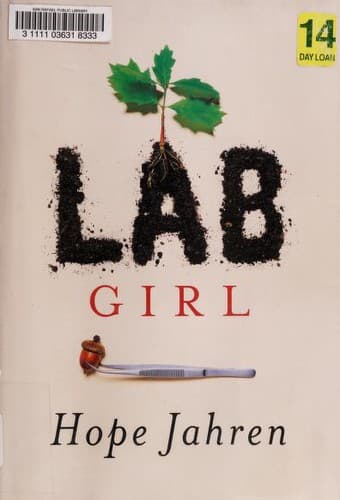
Book details and cover from Google Books.
Ready to read Lab Girl?
Get your copy on Amazon, or listen to it on Audible. We earn a commission if you buy through these links.