
We earn a commission if you buy through these links. Learn more
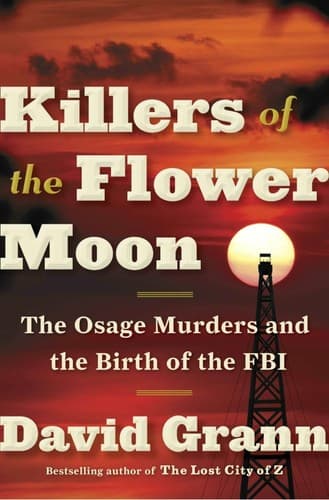
Killers of the Flower Moon
by David Grann, Luis Murillo Fort
On screen: Killers of the Flower Moon (film, 2023)
Guide by the Books of the Day editors · Updated · How we write our guides
A gripping, carefully reported account of the 1920s murders of Osage people who had become some of the richest in America, and the early FBI investigation that followed.
What It's About
David Grann's book is narrative nonfiction about the Osage Nation in northeastern Oklahoma during the 1920s. After oil was found beneath Osage land, members of the tribe received royalty payments under a system that made some individuals very wealthy. That money drew guardians, relatives, and opportunists who sought control of it, and a string of killings followed, many disguised as accidents, illness, or suicide.
Grann moves among several viewpoints: the Osage community, especially the Burkhart family, and the investigators, most prominently Tom White, a former Texas Ranger brought in to pursue the case. The book reads like a mystery and a courtroom story, built from archives, letters, court records, and interviews. In its final section Grann also writes as a reporter who travels to Oklahoma himself, which gives the book a different texture.
The experience is grim but compelling. Grann is careful about what he can prove and open about gaps in the record. The book is as much about how local authorities, a justice system, and a young federal agency failed a community as it is about the crimes themselves. Expect to feel more anger than closure when you finish.
Read this if you…
- want a true-crime narrative that reads like a thriller but rests on documented history
- are interested in the intersection of Indigenous history, oil wealth, and American justice
- want to understand how the early FBI took shape
Skip it if you…
- want a comprehensive history of the Osage Nation rather than one period and one case
- prefer fast, plot-driven storytelling with little attention to historical context
Key Ideas
- 1
Wealth that made a community a target
Oil royalties turned Osage families into people whose lives were worth more dead than alive to certain neighbors. Grann shows how the headright system, with its guardianships and legal controls, put individuals' money in the hands of people who had every reason to take it. The book makes clear that the murders were a product of a specific economic arrangement, not random violence.
- 2
Murder dressed up as ordinary death
Many of the deaths were recorded as natural causes or accidents, and local officials often accepted these explanations without serious inquiry. Grann examines how indifference, bias, and complicity allowed killers to operate for years. The theme is less about one villain than about a web of people who looked away.
- 3
The early FBI learning to investigate
The case became a proving ground for a federal investigative agency still establishing its methods and reputation. Grann traces how investigators gathered evidence, pursued suspects, and navigated politics. Readers get a clear sense of how institutions can be both capable and self-interested.
- 4
Reporting as an act of detective work
Grann's reporting process is part of the story. He shows how he pieced together fragments from archives and conversations, and he is honest about what remained uncertain. This transparency makes the narrative feel earned rather than dramatized.
Limitations
Some critics note that the book centers on the white investigators and the non-Osage perpetrators, which can give the federal agents more narrative weight than the Osage people whose lives were at stake. Because many records were incomplete or biased, parts of the story rest on inference, and Grann says so where it applies. The book covers one tragic episode, so it does not survey Osage history, culture, or the tribe's later life. Its shifting structure and the reporter-focused final section may also feel uneven to some readers.
Questions Readers Ask
- Is Killers of the Flower Moon still relevant today?
- Yes. The book addresses questions that remain central in American life: how resource wealth affects Indigenous communities, how justice systems treat victims who are not white, and how institutions respond to failure. It also helped bring wider public attention to the Osage story and to the origins of the FBI.
- How does it compare to In Cold Blood?
- Both are nonfiction crime books built with novelistic techniques and extensive reporting. Grann's book is broader in scope, covering a community, a money system, and a federal investigation rather than a single crime and its perpetrators. Readers who liked the immersive pacing of Capote's book will likely find Grann's similarly absorbing.
- Published
- 2017
- ISBN
- 9780593470831
- Difficulty
- beginner
- Category
- History
Book details and cover from Google Books.
Ready to read Killers of the Flower Moon?
Get your copy on Amazon, or listen to it on Audible. We earn a commission if you buy through these links.