
We earn a commission if you buy through these links. Learn more
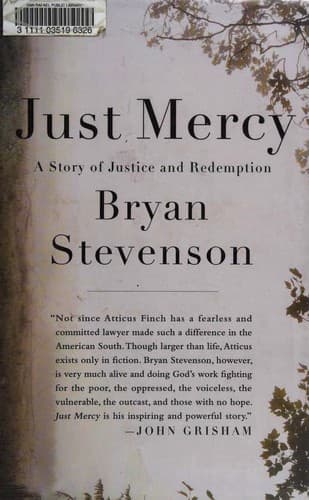
Just Mercy
Guide by the Books of the Day editors · Updated · How we write our guides
Bryan Stevenson's account of defending people on death row and children sentenced to life without parole is a moving, case-driven look at how the American justice system fails the poor and Black defendants.
What Creators Say About Just Mercy
2 creators reviewed Just Mercy on YouTube between 2016 and 2019, with 12.2M views between them. Their opinions are their own; we picked these reviews, we didn't write them.
What It's About
Just Mercy is Bryan Stevenson's account of his work as a defense lawyer in Alabama, where he founded the Equal Justice Initiative to represent people who have been condemned, wrongly convicted, or denied fair treatment. The book is part memoir and part case history. Its spine is the long fight to free Walter McMillian, a Black man sentenced to death for a murder he did not commit, but Stevenson keeps widening the frame to include other clients and the institutions that shaped their cases.
The writing is narrative and scene-driven rather than legal or academic. Stevenson moves between prison visits, courtrooms, and his own early experiences, and he weaves in the history of slavery, lynching, and segregation to show why these cases are not isolated accidents. Some chapters follow children sentenced to life without parole, and others sit with people awaiting execution. The experience is emotionally heavy and often angering, but the pace is steady and the prose is plain.
What makes the book worth reading is less its verdicts than its method. Stevenson argues that justice work depends on getting close to the people the system discards, and that a person should not be defined only by the worst thing they have done. Readers finish with a sharper sense of how poverty, race, and poor representation combine in criminal courts, and with a question about what mercy would require from everyone else.
Read this if you…
- want a human, story-based account of how the death penalty and sentencing work in practice
- are interested in how racial history shapes present-day criminal justice
- want to understand what a public defender or civil rights lawyer actually does day to day
Skip it if you…
- want a systematic policy analysis or a detailed comparison of reform proposals
- find emotionally intense true stories too draining to read right now
Key Ideas
- 1
Proximity as the basis for justice
Stevenson's central claim is that injustice persists partly because people with power rarely get close to those the system punishes. He argues that meeting clients, visiting prisons, and staying in the room with suffering changes how lawyers and citizens understand what is happening. The book treats proximity less as a sentiment than as a working discipline that exposes errors others miss.
- 2
Hopelessness as a driver of harsh outcomes
The book suggests that cruelty in the justice system often grows from despair rather than simple malice. Communities that feel abandoned, defendants who have never been given reason to hope, and officials who believe nothing can change all contribute to outcomes that look like punishment for its own sake. Stevenson uses this idea to explain why he insists on hope as a practical tool, not a comforting slogan.
- 3
Wrongful convictions and unequal representation
Through the McMillian case and others, the book shows how eyewitness errors, coerced or unreliable testimony, and inadequate defense can send innocent people to death row. It pays close attention to how poverty and race shape who gets a strong lawyer and who does not. Readers come away with concrete examples of how these failures unfold, not just general claims about bias.
- 4
The history behind present cases
Stevenson connects modern sentencing to slavery, lynching, and the Jim Crow era, arguing that the United States has never fully reckoned with that past. He frames contemporary outcomes as continuations of older patterns of racial control. This historical layer gives the individual stories a larger context and is one of the book's most distinctive features.
- 5
Mercy as a shared responsibility
The book ends up making a moral argument that mercy is not only a matter for courts or governors. Stevenson asks readers to consider whether a just society should define people by their worst acts and whether punishment can ever be separated from dignity. He offers the idea as a challenge to ordinary readers, not only to lawyers and policymakers.
Limitations
Critics have pointed out that the narrative leans heavily on Stevenson's own voice and perspective, and some readers find its emotional appeals more persuasive than its policy analysis. The book works through individual cases rather than offering a detailed blueprint for reform, and it does not survey the wider debate over capital punishment or the arguments of prosecutors and victims' families in depth. Some passages are sentimental, and a few readers find the heroic framing uncomfortable. Published in 2014, it also predates some legal and sentencing changes, so specific case details should be checked against current sources.
Questions Readers Ask
- Is Just Mercy still relevant today?
- Yes. The debates it covers, including the death penalty, life sentences for juveniles, and wrongful convictions, remain active in courts and legislatures. Some legal details have changed since 2014, so the book is best read as a grounded account of how these systems operate and why they are hard to reform, not as an up-to-date legal guide.
- How does Just Mercy compare to The New Jim Crow?
- Both books examine racial inequality in criminal justice, but they work differently. Michelle Alexander builds a systemic argument about mass incarceration as a modern caste system. Stevenson tells it through individual clients and cases. Readers who want a theory of the system may prefer Alexander, while readers who want to feel the human cost up close may find Stevenson more affecting.
- Published
- 1600
- ISBN
- 9781432878634
- Difficulty
- beginner
- Category
- Biographies
Book details and cover from Google Books.
Ready to read Just Mercy?
Get your copy on Amazon, or listen to it on Audible. We earn a commission if you buy through these links.