
We earn a commission if you buy through these links. Learn more
July 1914
A sourced, fast-moving reconstruction of the weeks before 1914's war that makes a provocative case for Russia's role in turning a regional crisis into a continental one.
What It's About
July 1914: Countdown to War by Sean McMeekin covers the five weeks between the assassination of Archduke Franz Ferdinand at Sarajevo on 28 June 1914 and the slide into general war in early August. It follows the crisis largely in sequence, moving between capitals as ultimatums are issued, armies are readied, and ministers try to read each other's intentions.
The book leans heavily on diplomatic cables, ministerial memoranda, and military planning documents from several governments. That gives the reader a sense of the crisis as a web of decisions made in St Petersburg, Vienna, Berlin, Paris, London, and Belgrade, often on partial or delayed information. McMeekin's central argument pushes against the familiar view that Germany alone bore the blame. He puts Russian backing of Serbia and Russian mobilization at the center of the story.
Reading it is a dense but propulsive experience. The pace comes from the accumulating deadlines rather than from narrative flourishes, and the prose is direct. Expect to keep many officials, treaties, and timetables in mind at once, and to weigh the author's interpretation against the evidence he presents. It rewards readers who want to follow the decisions themselves rather than receive a tidy summary of who was guilty.
Read this if you…
- want a detailed, document-driven account of the July 1914 crisis
- are willing to revise a simple story of who started the First World War
- enjoy following diplomatic and military decisions hour by hour
Skip it if you…
- want a broad introduction to the whole of the First World War
- prefer a narrative without many names, dates, and competing governments to track
Key Ideas
- 1
Russia as an active driver of the crisis
McMeekin argues that St Petersburg was not a passive partner to Serbia but an actor whose firm support and military preparations narrowed the choices available to everyone else. The book's value lies in how it tests this claim against the diplomatic record, so readers can judge the argument on the evidence.
- 2
Mobilization turning a local dispute into war
Military timetables meant that mobilizing one army forced others to follow, so the crisis escalated faster than political leaders intended. The book shows how planning assumptions, not just statesmen's aims, shaped what happened in the final days before the declarations of war.
- 3
Diplomacy under deadline pressure
Ultimatums, delayed telegrams, and misread signals repeatedly pushed governments toward decisions they had not fully weighed. McMeekin uses these moments to show how a crisis can outrun the people managing it, which is a theme that carries well beyond 1914.
- 4
The Entente capitals and their calculations
The book gives real attention to Paris and London and to how their positions influenced Berlin and Vienna. Readers come away seeing the July crisis as a set of interacting choices rather than a single German-led sequence.
Limitations
The book's central thesis is contested, and critics argue it gives too little weight to decisions in Berlin and Vienna, including the German assurance of support for Austria-Hungary. Its tight focus on five weeks means it says little about the years before 1914, the fighting itself, or the social and economic conditions behind the war. Readers who want a more even-handed account of shared responsibility often pair it with Christopher Clark's The Sleepwalkers. Its density can also make it hard going without some prior background.
Questions Readers Ask
- Who is July 1914 best suited for?
- It suits readers who already know the basic outline of the First World War and want to see how the crisis unfolded. Its heavy use of diplomatic and military sources makes it especially rewarding for anyone interested in how decisions were made under pressure, but casual readers may find the cast of officials and dates demanding.
- How does it compare with Christopher Clark's The Sleepwalkers?
- Both books cover the same crisis, but they reach different conclusions. Clark stresses shared responsibility and the general failure of leaders to control events. McMeekin puts more weight on Russia's role. Reading both gives a fuller sense of the historiographical debate than either provides alone.
- Is the book still relevant to historians today?
- Yes. It belongs to an ongoing debate about how to assign responsibility for 1914, and it has been part of that discussion since its publication. Its arguments remain a useful test case for anyone studying how crises escalate.
- Published
- 2013
- ISBN
- 9780465031450
- Difficulty
- intermediate
- Category
- History
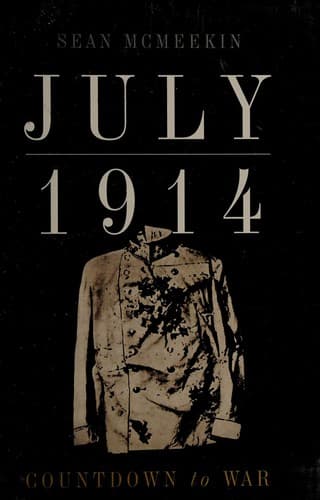
Book details and cover from Google Books.
Ready to read July 1914?
Get your copy on Amazon, or listen to it on Audible. We earn a commission if you buy through these links.