
We earn a commission if you buy through these links. Learn more
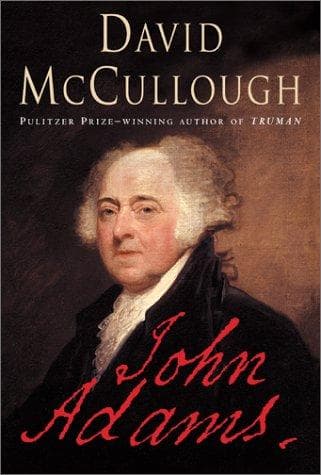
John Adams
Guide by the Books of the Day editors · Updated · How we write our guides
A long, warm, letter-driven portrait of the lawyer who helped win American independence and became its second president, and who was as thorny as he was principled.
What Creators Say About John Adams
2 creators reviewed John Adams on YouTube between 2020 and 2022, with 3.5K views between them. Their opinions are their own; we picked these reviews, we didn't write them.
What It's About
John Adams traces the life of a Massachusetts lawyer who became one of the central figures of American independence and then the country's second president. David McCullough follows him from a farm-town childhood through the Revolution, the Continental Congress, diplomatic postings in Europe, the vice presidency, and the presidency, before ending with his later years back in Quincy.
McCullough builds the book largely from letters between Adams and his wife Abigail, along with Adams's own diaries. That gives the story the texture of a close-up on a marriage and a restless, argumentative mind rather than a survey of events. The prose is vivid and brisk, moving through debates in Philadelphia, Atlantic crossings, and political fights in the new capital while keeping Adams at the center of almost every scene.
Reading it is an immersive, admiring experience. You come away with a strong sense of how the early republic was improvised by people who disagreed fiercely and often said so candidly in private. It rewards patience and steady attention more than skimming, and it is best read as a long companion book across several evenings.
Read this if you…
- want a detailed, character-centered history of the founding era
- enjoy reading personal letters and diaries as a window into the past
- are curious about the early presidency and the rivalries that shaped it
Skip it if you…
- want a quick overview or a book you can finish in a week
- are looking for a critical, debunking account of the Founders
Key Ideas
- 1
Independence as an argued, uncertain project
The book shows the Revolution as something people debated, doubted, and sometimes nearly abandoned, not a foregone conclusion. Adams is shown pushing Congress toward independence while worrying about whether the colonies could hold together. That tension between conviction and anxiety runs through the whole narrative and makes the early chapters of the struggle feel open-ended.
- 2
The Adams marriage as a second narrative
Abigail's letters give the book a parallel story about a partnership conducted across long separations, with Abigail managing the farm and family while her husband served abroad. Her shrewd, unsentimental observations often sharpen the reader's view of Adams. The relationship is treated as central to his life, not as background color.
- 3
Principle that cost Adams politically
Adams is portrayed as a man who often chose what he thought was right over what was popular, including positions that alienated his own allies. His presidency is presented as a case study in this: a leader who held to his judgment even when it damaged his standing. McCullough admires this stubbornness while showing its personal price.
- 4
Vanity and temper alongside integrity
The book does not present Adams as a flawless founder. His vanity, quick temper, and sensitivity to slights come through clearly in his own writing, and McCullough lets those traits show. The result is a figure who is more human and more contradictory than the monument-like image many readers carry.
Limitations
Critics sometimes say the book is more sympathetic to Adams than a fully balanced account would be, and that it can lean on his self-revealing writing more than on opposing sources. Some readers find the legislative and diplomatic detail heavy, and the length can make the middle sections feel slow. It is a biography of one man rather than a broad social history, so the lives of enslaved people, women outside the Adams circle, and many other participants receive comparatively little space.
Questions Readers Ask
- Is John Adams a good first book about the founding era?
- It can be, if you are willing to commit to a long read. McCullough explains the political background clearly and keeps the narrative moving. Readers who want a shorter introduction might start with a single-event history of the Revolution, then return to this for depth on one of its most intense participants.
- How does it compare with Hamilton-era biographies or the Hamilton musical?
- It is less dramatic and far less stylized than the musical, and it spends much more time on Adams's family life and private doubts. Compared with a typical political biography, it is more intimate and more reliant on letters, so it suits readers who enjoy domestic detail alongside public events.
- Is the book still relevant today?
- Yes. Its questions about how a new republic should handle partisan conflict, executive power, and a free press remain live topics. Because the book is anchored in one person's experience, it also offers a useful way to think about those issues without reading a textbook.
- Published
- 2001
- ISBN
- 9780684813639
- Difficulty
- intermediate
- Category
- Biographies
Book details and cover from Google Books.
Ready to read John Adams?
Get your copy on Amazon, or listen to it on Audible. We earn a commission if you buy through these links.