
We earn a commission if you buy through these links. Learn more
Jane Eyre
Guide by the Books of the Day editors · Updated · How we write our guides
Charlotte Brontë's 1847 classic about a plain, principled governess who refuses to trade her integrity for security makes a sharp, emotional read for anyone who loves a fierce heroine.
What Creators Say About Jane Eyre
2 creators reviewed Jane Eyre on YouTube between 2014 and 2018, with 1.8M views between them. Their opinions are their own; we picked these reviews, we didn't write them.
What It's About
Jane Eyre is narrated in the first person by Jane herself, who looks back on her life from a difficult childhood as a dependent orphan in her aunt's household through to her working years as a governess. The opening section sets the terms of the whole book: Jane is poor, unloved by the people who should protect her, and quick to notice the injustice around her. The novel then follows her through a harsh boarding school and into a position at a country house, where the rhythm of ordinary work gives way to something stranger and more charged. Much of the book's force comes from how Jane thinks, not only from what happens to her.
Brontë's style is the main reason people still read it. Jane's voice is direct, observant, and often sharp-tongued, and she addresses her own feelings with a bluntness that still feels fresh. The book blends domestic realism with Gothic atmosphere: unexplained noises, a locked upper floor, storms that seem to match the emotional weather. The moral seriousness can read as earnest or even preachy to modern ears, but it is also what gives the book its spine. Passages of real passion sit alongside long stretches of self-examination.
Reading Jane Eyre is more an emotional experience than a puzzle. It is long, and the middle sections move slowly, with much of the tension coming from arguments Jane has with herself about duty, desire, and self-respect. Expect Victorian pacing and sentences that can be dense. A reader who settles into the rhythm, though, will find the book unusually intimate, a portrait of a mind insisting on its own worth.
Read this if you…
- want a heroine whose inner voice carries the whole book
- enjoy a slow-building romance driven by argument and tension rather than action
- are curious where modern romance and feminist fiction took many of their starting points
Skip it if you…
- want fast plotting, a light read, or a book you can finish in a weekend
- dislike long moral lectures, religious passages, and extended self-examination
Key Ideas
- 1
Independence as a moral duty
Jane's central conviction is that a person owes it to herself to keep her own judgment and standards, even when dependence would be easier. The book treats self-respect not as vanity but as a form of honesty. Jane repeatedly chooses the harder path when the easier one would require her to pretend, flatter, or surrender her principles to someone with more money or power.
- 2
Passion weighed against principle
The novel is structured around a tension between strong feeling and firm conviction. Jane is not cold, and her attachments run deep, but she insists that love cannot justify deceit or the loss of self. Many readers find this the most modern thread in the book, because it asks whether romantic intensity should ever outweigh a person's own sense of right and wrong.
- 3
Class, money, and the cost of dependence
Social standing and financial security shape almost every decision in the book. Jane's life is constrained by what her position allows her to do, and Brontë is sharp about how wealth is inherited, performed, and sometimes hidden. Reading the novel with attention to money makes its choices feel less like abstract virtue and more like a struggle against real material limits.
- 4
Gothic form carrying inner turmoil
Brontë borrows the furniture of the Gothic novel, including isolated houses, secrets, and eerie sounds, but uses it to externalize Jane's inner state rather than simply to thrill. The atmosphere is a tool for showing fear, longing, and suspicion. This blend of plain realism and heightened drama is a large part of why the book feels distinctive compared with many of its contemporaries.
Limitations
The book's moral voice can feel heavy-handed, and some of its religious passages are long enough to test patience. Certain plot coincidences and dramatic turns strike many modern readers as contrived, and the Victorian melodrama can read as overwrought. The novel also draws its financial comfort from colonial sources that it mentions but does not examine closely. Readers looking for a fully modern perspective on class, empire, or the position of women outside Jane's circle will find the book's view limited by its period.
Questions Readers Ask
- Is Jane Eyre still worth reading today?
- Yes, especially if you want a narrator with a strong, unusually candid inner life. The prose can be dense and the pacing slow by current standards, but the book's questions about independence, self-respect, and the cost of dependence still feel pressing. Many readers find it more rewarding on a second reading, once the plot is no longer the main draw.
- How does Jane Eyre compare to Wuthering Heights?
- Both novels are by Brontë and share a Gothic sensibility, but they feel quite different. Jane Eyre has a steadier, more controlled first-person narrator and a stronger focus on moral choice. Wuthering Heights is wilder, more fragmented, and more interested in obsession and cruelty. Readers who enjoy one often find the other rewarding, though Jane Eyre is usually the easier starting point.
- Published
- 1847
- ISBN
- 9798518833760
- Difficulty
- intermediate
- Category
- Fiction
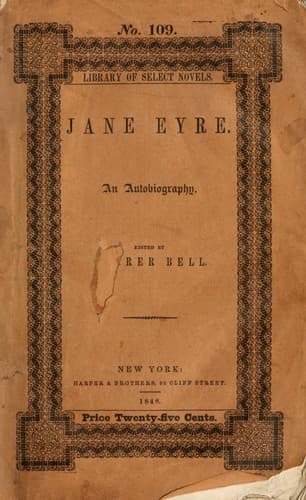
Book details and cover from Google Books.
Ready to read Jane Eyre?
Get your copy on Amazon, or listen to it on Audible. We earn a commission if you buy through these links.