
We earn a commission if you buy through these links. Learn more
Ivanhoe
Guide by the Books of the Day editors · Updated · How we write our guides
Scott's 1819 medieval adventure pairs a Saxon-Norman rivalry, a great tournament and a siege with memorable characters, and it shaped how later writers imagined the Middle Ages.
What Creators Say About Ivanhoe
2 creators reviewed Ivanhoe on YouTube between 2019 and 2024, with 11.5K views between them. Their opinions are their own; we picked these reviews, we didn't write them.
What It's About
Ivanhoe is a historical novel set in England in 1194, when Richard I is away on the Crusades and his brother John is maneuvering for the throne. Scott follows Wilfred of Ivanhoe, a young Saxon knight who has been cut off from his father over his loyalty to a court dominated by Normans. His path crosses with outlaws, Jewish merchants, Templar knights and the nobility of the period, and the story turns on the uneasy relationship between Saxons who lost their land and the Normans who took it.
Scott's approach is panoramic. Much of the book is spent setting scenes in careful detail: forests, castle halls, a famous tournament, a besieged manor, the clothing and customs of each group. The dialogue shifts register depending on who is speaking, with Saxon characters given a plainer, more rustic idiom, and the prose has the stately rhythm of early nineteenth-century historical writing. Expect a slow start, then a run of set pieces that move quickly.
Reading it feels like settling into a long, old-fashioned romance built on real history. The pleasures lie in scenes and characters rather than in twisty plotting, and the book's influence on later adventure fiction, including countless Robin Hood retellings, is easy to see. It rewards patience more than speed.
Read this if you…
- love long, immersive historical novels with strong set pieces
- are curious where the modern image of Robin Hood and medieval knighthood came from
- want an adventure story that also looks at ethnic and religious prejudice in the past
Skip it if you…
- want fast pacing and tight, modern plotting from the first page
- find archaic, formal dialogue and long descriptions tiring rather than atmospheric
Key Ideas
- 1
Conquest and the resentment of the defeated
The novel is driven by the aftermath of the Norman Conquest, when the old English nobility lost land and status to newcomers. Scott shows how this grievance shapes friendships, marriages and political loyalties, and how the two peoples slowly begin to merge into one nation, though not without friction.
- 2
Chivalry as ideal and as performance
Knightly honor is presented both as a genuine moral code and as a public display. The tournament scenes show men competing for glory and favor, while other characters expose how easily the code is bent by ambition, greed or cruelty. The tension between the ideal and the reality is what gives the romance its weight.
- 3
Prejudice and tolerance across faiths
Scott gives real attention to the persecution of Jewish characters in medieval England, including extortion and open hostility. His sympathies are clearly with the mistreated, though some of his portrayals rely on the assumptions of his era. Readers will find this one of the book's most discussed and debated threads.
- 4
Legitimacy, loyalty and the crown
Beneath the adventures is a political question: who deserves to rule while the king is absent. Prince John's scheming and the loyalty of various lords show how power depends on oaths, alliances and rumor as much as on law. The stakes feel practical rather than abstract.
- 5
Panoramic storytelling and set pieces
Scott's distinctive method is to build a wide canvas of places, people and social classes, then drop his characters into vivid episodes such as a tournament, a siege and an outlaw camp. Readers who enjoy immersion in a historical world will find this rewarding, even when the pacing is leisurely.
Limitations
The novel idealizes certain aspects of medieval life, especially the chivalric code and the figure of Richard, and modern readers may find its view of the past more romantic than accurate. Its opening chapters are slow, and its long descriptive passages can feel heavy. Some portrayals of Jewish characters draw on stereotypes of the period that many readers now find uncomfortable. Robin Hood appears in a relatively minor role compared with later versions of the legend.
Questions Readers Ask
- Is Ivanhoe still worth reading today?
- Yes, especially if you enjoy classic historical fiction or want to see where many later medieval adventures began. Its prose and pacing are old-fashioned, so it works best for readers willing to slow down. Its questions about conquest, prejudice and loyalty still resonate, though some of its historical picture is idealized.
- How does Ivanhoe compare to Scott's Waverley?
- Waverley is Scott's earlier novel and is set during the Jacobite uprising of 1745. Ivanhoe is more of a medieval adventure, with a wider cast and more spectacular set pieces. Readers who like the broad social scope of Waverley will likely enjoy Ivanhoe's pageantry, but it is more openly romantic.
- Do I need to know medieval history first?
- No. Scott introduces the political situation of 1194 gradually through the characters and their conversations. A rough sense of Richard I, Prince John and the Norman-Saxon divide helps, but the story is self-contained enough that a reader can follow it without preparation.
- Published
- 1800
- ISBN
- 9781500709143
- Difficulty
- intermediate
- Category
- Fiction
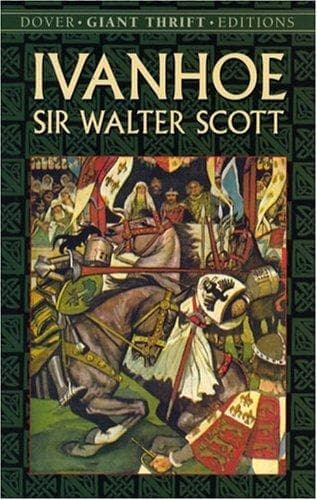
Book details and cover from Google Books.
Ready to read Ivanhoe?
Get your copy on Amazon, or listen to it on Audible. We earn a commission if you buy through these links.