
We earn a commission if you buy through these links. Learn more
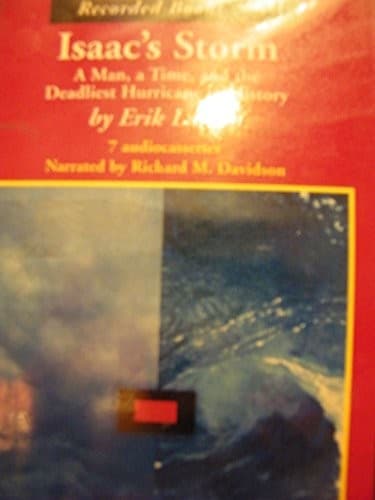
Isaac's Storm
by Erik Larson, Richard M. Davidson
Larson turns the 1900 Galveston hurricane into a tense human drama about a weather observer, a stubborn institution, and the limits of expert confidence.
What It's About
Isaac's Storm is a narrative account of the 1900 hurricane that struck Galveston, Texas, killing thousands of people in a city that had little warning and less understanding of what was coming. Erik Larson builds the story around Isaac Cline, the local head of the U.S. Weather Bureau office, a dedicated observer who had been taught that hurricanes could not be forecast with any confidence and that the island city was not seriously at risk.
Larson moves between Cline's life and work, the institutional politics of the Weather Bureau in Washington, the evidence that reached the island by telegraph and from Cuba, and the slow approach of the storm itself. The approach is closer to a novelist's than a textbook's. Scenes are assembled from letters, reports, and period detail, and the tension builds through accumulating small signals rather than through formal argument. Reading it feels like watching a slow approach whose outcome you already know.
The book is less a lesson in meteorology than a study of how institutions handle uncertainty, how confident experts can be wrong, and how a community's trust in its own assumptions can cost lives. The science stays in the background, and the human stakes move to the front.
Read this if you…
- want narrative nonfiction that reads like a novel
- are curious about how early science and government handled a major disaster
- enjoy stories about ordinary people caught in large historical events
Skip it if you…
- want a technical explanation of how hurricanes form or how modern forecasting works
- need a detailed, footnote-heavy history of the Weather Bureau or of Galveston's politics
Key Ideas
- 1
Forecasting was not yet a real discipline
In 1900, weather work was mostly observation and reporting, not prediction. Hurricanes were poorly understood, and many experts believed they could not be reliably forecast. The book shows how that assumption shaped what the Weather Bureau told people, and why warnings were slow or softened.
- 2
Institutional confidence and its blind spots
Larson shows a federal agency protective of its own methods and reluctant to accept outside evidence, including warnings from Caribbean forecasters. The story is as much about bureaucratic habit and pride as about the storm, and it asks readers to notice how easily an authority can dismiss information it is not set up to handle.
- 3
One man at the center of the disaster
Cline is a sympathetic and capable figure whose mistakes come from his beliefs, not from carelessness. Seeing events through his eyes gives the narrative its emotional weight, and it lets Larson examine guilt, duty, and the personal cost of being wrong in public.
- 4
Water, not just wind, was the danger
The killing force on a flat, low island was the storm surge rolling over the town. Larson makes the geography vivid, so readers understand why ordinary precautions failed. The aftermath, including the building of a seawall and the raising of the city's grade, shows how a disaster can reshape a place's future.
Limitations
Larson's dramatic framing sometimes leans on suspense and personal focus, and some readers find that it simplifies the institutional and scientific debates of the period. The book is about one storm and one city, so it says little about hurricanes in general or about later advances in forecasting, satellites, and evacuation planning. Its science is dated, and its portrait of Cline has been questioned by some who feel the bureaucratic story is more complicated than the narrative allows. Some readers also find the early chapters slower than the storm sections that follow.
Questions Readers Ask
- Who is Isaac's Storm best suited for?
- It suits readers who like narrative history written with the pacing of a thriller. You do not need a background in meteorology or American history. If you enjoy books that combine a single disaster with a close look at the people involved, it will likely hold your attention from start to finish.
- How does it compare to Larson's Devil in the White City?
- Both use a historical event as a vehicle for character-driven storytelling and parallel threads. Isaac's Storm is narrower in scope, centered on one storm and one central figure, while Devil in the White City covers a broader cultural setting. Readers who enjoyed the pacing of one often enjoy the other.
- Published
- 2000
- ISBN
- 9780788743047
- Difficulty
- beginner
Book details and cover from Google Books.
Ready to read Isaac's Storm?
Get your copy on Amazon, or listen to it on Audible. We earn a commission if you buy through these links.