
We earn a commission if you buy through these links. Learn more
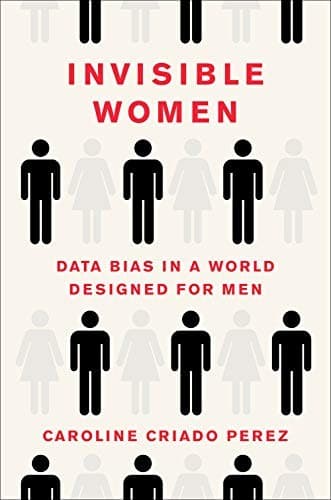
Invisible Women
Guide by the Books of the Day editors · Updated · How we write our guides
A well-sourced, fast-moving case that much of the modern world is built around a male default, showing how missing data leads to products, policies and spaces that quietly fail half the population.
What Creators Say About Invisible Women
2 creators reviewed Invisible Women on YouTube between 2019 and 2020, with 62.9K views between them. Their opinions are their own; we picked these reviews, we didn't write them.
What It's About
Invisible Women, published in 2019, argues that men are treated as the default human across much of public life, and that women's experiences are missing from the data that shapes products, workplaces, medicine and cities. Caroline Criado Perez builds the case from a long run of examples and treats the missing data as the root problem, rather than as a series of isolated oversights by individual designers or doctors.
The reading experience is closer to investigative journalism than to an academic monograph. Chapters move quickly between sectors, usually opening with a concrete case and then widening out to the research behind it. She draws on a great many studies and figures, and the momentum comes from accumulation: any single example can seem minor, but dozens together start to look like a pattern. The tone is direct and often indignant, which some readers find energizing and others find relentless.
The book works best as a catalogue of problems and a case for measuring things differently. It is less a guide to solving them. Its policy ideas are present but comparatively brief. Expect to finish angry, curious, and with a long list of questions you will want to pursue in other sources.
Read this if you…
- Want a well-sourced case for why supposedly neutral systems often are not neutral
- Work in product design, policy, medicine or research and want to check your assumptions
- Are interested in gender equality but have not yet seen how it shows up in everyday objects and data
Skip it if you…
- Want a practical playbook or detailed policy solutions
- Prefer a calm, neutral tone and get irritated by openly argued advocacy
Key Ideas
- 1
Men as the default human
The book's central claim is that male bodies, male habits and male experiences are treated as the standard, while women are treated as a variation to be accommodated, if they are considered at all. Criado Perez traces how this assumption quietly shapes decisions that look neutral on the surface.
- 2
The gender data gap
Much of the information that governments, companies and researchers rely on is never broken down by sex, or is gathered from samples dominated by men. Policies built on that information inherit the gap, so the problem is often invisible to the people making the decisions.
- 3
Design built around an average man
Crash test dummies, office temperature standards, tools and phones are often sized or calibrated to male averages. The examples are concrete and sometimes alarming, showing how small design defaults can translate into real differences in injury, discomfort and access.
- 4
Unpaid care work left out of view
Work done in homes and families, which falls disproportionately to women, is poorly counted in economic measures and rarely factored into how transport, services and cities are planned. The book argues that leaving it out distorts priorities in ways most people never notice.
- 5
Measuring differently as the first step
The practical thread running through the book is that fixing the problem starts with collecting sex-disaggregated data and asking who a product or policy was actually designed to serve. The argument is persuasive, though the book spends more time diagnosing than prescribing.
Limitations
Critics note that the book is advocacy as much as analysis, and that its sweeping framing sometimes runs ahead of the evidence in individual cases. Some examples come from specific studies or regions and may not generalise as neatly as the prose suggests. Intersectional issues of race, class and disability receive less attention than they could. Because it was written in 2019, some figures and products have since been updated, and readers should check newer sources for current numbers.
Questions Readers Ask
- Is Invisible Women still relevant today?
- Yes, the core argument about missing data and default designs remains widely discussed, and examples such as crash testing and the exclusion of women from medical trials are still central to debates about bias. Some specific statistics and products have changed since 2019, so it is worth checking newer sources for current figures.
- How does it compare with Delusions of Gender by Cordelia Fine?
- Fine focuses on the science of sex differences and critiques claims that brains are fundamentally different between men and women. Criado Perez takes the existence of gender gaps as a starting point and focuses on how data collection and design choices create and sustain them. Reading both gives a fuller picture of the debate.
- Published
- 2019
- ISBN
- 9787513349611
- Difficulty
- beginner
- Category
- Tech
Book details and cover from Google Books.
Ready to read Invisible Women?
Get your copy on Amazon, or listen to it on Audible. We earn a commission if you buy through these links.