
We earn a commission if you buy through these links. Learn more
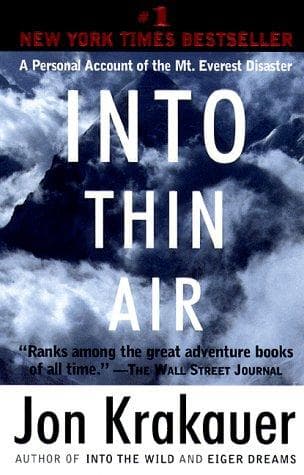
Into Thin Air
by Jon Krakauer
Guide by the Books of the Day editors · Updated · How we write our guides
Jon Krakauer's account of the 1996 Everest storm that killed eight climbers, with a close look at guiding, commercial risk, and fatal decisions.
What Creators Say About Into Thin Air
2 creators reviewed Into Thin Air on YouTube between 2016 and 2025, with 9.6K views between them. Their opinions are their own; we picked these reviews, we didn't write them.
What It's About
Into Thin Air is Jon Krakauer's first-hand account of the spring 1996 climbing season on Mount Everest, when a sudden storm caught several commercial expeditions high on the mountain and eight people died. Krakauer was in the field as a journalist on assignment for Outside magazine, climbing with a guided team run by Rob Hall, so much of the book is written from inside the expedition, close to the people making the calls.
The approach is reportorial and personal at once. Krakauer narrates the climb in order, explains the physical toll of altitude and the role of supplemental oxygen in plain terms, and stops often to reconstruct what different people knew and when they knew it. He is candid about his own mistakes and doubts, which gives the book an unusually frank tone for a disaster narrative. The reading experience is tense and fast-moving, but it also asks you to hold several overlapping timelines and a long cast of guides, clients, and support staff in your head.
The book is less a how-to of mountaineering than an argument about how the business of guided Everest expeditions shaped the outcome. Krakauer keeps returning to money, ambition, and the pressure to reach the summit, and he is pointed about the gap between what clients were promised and what the mountain demanded.
Read this if you…
- are curious about how high-altitude expeditions actually work from the inside
- want a gripping true story that also raises questions about money and risk
- enjoy first-person reporting that admits the writer's own errors
Skip it if you…
- want a technical guide to climbing or a survival manual
- need a neutral, multi-source history of Everest rather than one writer's perspective
Key Ideas
- 1
Commercial guiding changes the risk
Krakauer argues that when paying clients buy a route to the summit, the mountain becomes a product and the margin for error shrinks. He examines how fees, schedules, and the need to deliver a successful climb can push experienced leaders toward decisions they might otherwise reject.
- 2
Turnaround times are easy to break
A recurring theme is the difference between a rule that is written down and one that is actually followed. Krakauer shows how summit goals, fatigue, and group momentum can slowly override the time limits that are supposed to protect climbers on the way back down.
- 3
Oxygen and altitude impair judgment
The book explains how hypoxia degrades thinking long before a climber feels seriously unwell. This helps readers understand why some people made choices that looked obviously wrong from the outside, and why even strong, experienced climbers were not reliable judges of their own condition.
- 4
Responsibility is hard to assign
Krakauer does not offer a clean villain. He weighs the choices of guides, clients, and himself, and he is unsparing about his own part. The result is a study of how shared decisions and bad luck combine, and why blame after a disaster tends to be messy.
Limitations
Krakauer's account has been challenged, most notably by Anatoli Boukreev, a guide whose conduct the book criticizes and who later published his own version of events. Some readers feel the narrative leans toward certain people and against others, and that Sherpa perspectives receive less space than Western climbers' experiences. The book also reflects the commercial Everest of the mid-1990s, so its warnings about crowding and guiding have aged in some ways even as the core lessons remain relevant. Later editions added material responding to critics.
Questions Readers Ask
- Do I need climbing experience to enjoy Into Thin Air?
- No. Krakauer explains the terms, physiology, and logistics as he goes, and the story is driven by people and events rather than technical detail. Some familiarity with mountains helps, but general adult readers are the intended audience and usually find it accessible.
- Is Into Thin Air still accurate and relevant?
- It is one writer's account of a specific 1996 season, so it is not a complete record. Its central questions about guided expeditions, risk, and decision-making remain relevant. For a fuller picture, read it alongside the other participants' accounts, especially Boukreev's response.
- Published
- 1996
- ISBN
- 9780807288283
- Difficulty
- beginner
- Category
- History
Book details and cover from Google Books.
Ready to read Into Thin Air?
Get your copy on Amazon, or listen to it on Audible. We earn a commission if you buy through these links.