
We earn a commission if you buy through these links. Learn more
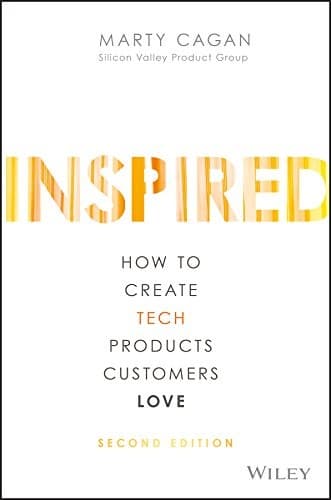
Inspired
by Marty Cagan
Guide by the Books of the Day editors · Updated · How we write our guides
A clear-eyed case for product teams that test ideas with customers before engineering builds them, plus a practical guide to escaping the feature factory trap.
What Creators Say About Inspired
2 creators reviewed Inspired on YouTube between 2021 and 2022, with 20.8K views between them. Their opinions are their own; we picked these reviews, we didn't write them.
What It's About
Inspired is Marty Cagan's book on how software companies can build products that customers actually want and that the business can sustain. Its central argument is that many tech organizations are set up to deliver a list of features on schedule, and that this model rarely produces products people love. Cagan separates delivery teams that execute a roadmap from empowered teams that are given a problem to solve and held accountable for the results.
The book reads as a practitioner's manual rather than an academic text. Cagan explains how product managers, designers, and engineers should work together during discovery, how to validate ideas through prototypes and testing before committing engineering effort, and how to think about the risks a product carries. The tone is direct and opinionated, with plenty of pointed comments about common organizational habits.
Reading it feels like sitting in on a long conversation with someone who has watched many teams succeed and fail. It focuses on process, roles, and mindset more than on specific tools, so the ideas stay useful as technology changes. Expect it to challenge how your company plans and measures work, and to be most rewarding if you are close to product decisions.
Read this if you…
- work on or near product decisions and want a shared vocabulary for how discovery should work
- are a product manager, designer, or engineering lead trying to move a team away from feature-factory habits
- prefer a frameworks-driven argument over long case-study storytelling
Skip it if you…
- want a light read or a quick summary you can finish in an evening
- are looking for step-by-step templates, checklists, or guidance for a very early-stage startup with no existing product
Key Ideas
- 1
Empowered product teams versus feature teams
Cagan argues that the biggest difference between strong and weak tech companies is whether teams are handed solutions to build or problems to solve. Feature teams tend to ship what they are told and measure output. Empowered teams own outcomes, which forces them to understand customers, question assumptions, and take responsibility for whether the product works in the market.
- 2
Discovery must come before delivery
A large part of the book argues that teams should spend real time figuring out what to build before engineers start building it. Cagan describes discovery as a continuous practice of testing ideas cheaply, often with prototypes and direct customer contact, so that weak ideas die early and only promising ones move into full development.
- 3
The four big product risks
Cagan frames product work around a few recurring questions: will customers want this, can they figure out how to use it, can we build it with our technology and people, and does it work for the business. Keeping all four in view helps teams avoid the common trap of solving only the engineering or only the business side of a problem.
- 4
Vision, strategy, and principles over roadmaps
The book is skeptical of roadmaps that promise fixed features on fixed dates, since they hide what the team actually knows. Cagan favors a clear product vision, a strategy for reaching it, and shared principles that guide daily choices, leaving room for teams to find better solutions than the ones first imagined.
Limitations
Some readers find the book repetitive, and its strong preference for one model of empowered teams can feel dogmatic, especially in organizations with different constraints. It assumes a fairly sizable company with dedicated engineering teams, so it says less about solo founders or small shops. Topics such as pricing, go-to-market, and detailed analytics get little attention. Advice on persuading executives to change how they work is thinner than the rest of the material, and some of the industry examples feel dated.
Questions Readers Ask
- Who is Inspired best suited for?
- It suits product managers, product designers, engineering leaders, and executives who influence how product work is organized. Readers who already see work through a project or feature lens will get the most from its argument. Complete newcomers to software can still follow it, but they may find some of the organizational advice more useful once they have worked on a product team.
- How does Inspired compare to The Lean Startup?
- The Lean Startup, by Eric Ries, focuses on how new ventures run experiments to find a business model. Inspired is aimed at established product organizations and asks how to structure teams, make decisions, and discover what to build. Many readers pair them, using Ries for the startup mindset and Cagan for the day-to-day working practices inside larger companies.
- Published
- 2008
- ISBN
- 9789352131501
- Difficulty
- intermediate
- Category
- Tech
Book details and cover from Google Books.
Ready to read Inspired?
Get your copy on Amazon, or listen to it on Audible. We earn a commission if you buy through these links.