
We earn a commission if you buy through these links. Learn more
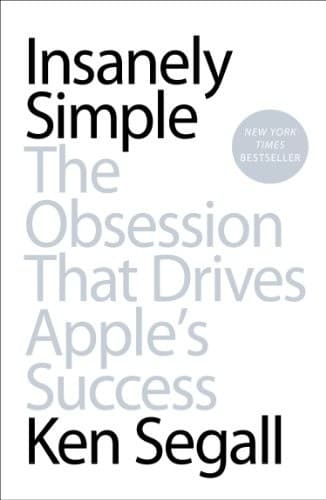
Insanely simple
by Ken Segall
Guide by the Books of the Day editors · Updated · How we write our guides
A close-up look at how Apple's obsession with simplicity shaped its products, written by an outside creative who worked on the account, and useful well beyond tech.
What Creators Say About Insanely simple
2 creators reviewed Insanely simple on YouTube between 2014 and 2023, with 1.6K views between them. Their opinions are their own; we picked these reviews, we didn't write them.
What It's About
Insanely Simple is Ken Segall's account of how Apple's pursuit of simplicity worked in practice, written by someone who spent years outside the company as an advertising creative. Segall was part of the agency team that handled Apple's work during its comeback years, and he describes the naming, campaigns, and internal decisions he saw up close. The result is less a manual than a set of observations about what simplicity actually demands from people who have to make hard choices.
The approach is conversational and anecdotal. Segall moves between stories about specific projects and broader lessons about focus, naming, and the discipline of cutting things out. Each section tends to hang on one idea and then illustrate it with examples, so the book reads quickly and rarely gets bogged down in dense theory.
What you get is a sense of the trade-offs involved: why saying no is harder than it sounds, and why simple products usually hide a great deal of complicated work. It is a book about one company's habits more than a general framework, so it works best as a lively case study you can apply to your own work rather than a step-by-step method.
Read this if you…
- are interested in how product and marketing decisions shape a company's identity
- want an insider's view of Apple during its turnaround years
- work in design, branding, or product and want a readable case for focus
Skip it if you…
- want a detailed history of Apple or its executives, since the book covers a narrower slice
- are looking for a step-by-step framework with exercises and checklists
Key Ideas
- 1
Simplicity as a deliberate business strategy
Segall argues that simplicity is not a design afterthought but a way of running a company. It shapes what gets built, how products are named and sold, and which projects a team agrees to pursue at all. Seen this way, a clean product is the visible result of many earlier decisions about what not to do.
- 2
Saying no as the core discipline
Focus means rejecting many ideas that are good on their own terms. The book treats refusal as a skill rather than a personality trait, and it shows how hard it becomes inside a large organization where every feature has an internal sponsor and every product line has defenders.
- 3
Naming and messaging as product decisions
Names and marketing are part of the product, not packaging added at the end. Drawing on his own naming work, Segall suggests that a clear, memorable name does real work for customers by reducing confusion and explaining what a product is for.
- 4
Hidden complexity behind a simple surface
A simple experience usually requires heavy effort behind the scenes. Segall's point is that simplicity is earned through rigor and persistence, and that the people who make things look easy are often the ones who worked hardest to remove the difficult parts.
Limitations
The book centers on one company and one perspective, and Segall's view is shaped by his role as an outside agency creative, so it leans on anecdote and admiration more than independent analysis. Readers wanting critical scrutiny of Apple's supply chain, labor practices, or later controversies will not find it here. Some examples are tied to the product era of the early 2000s and can feel dated, and the style may seem repetitive when the same point returns across sections.
Questions Readers Ask
- Is Insanely Simple still worth reading today?
- The specific products it discusses are dated, but the underlying argument about focus and saying no travels well. Read it for the reasoning and the behind-the-scenes perspective rather than as a current account of Apple. The examples matter more than any predictions the author makes about the company's future.
- How does it compare to Walter Isaacson's Steve Jobs biography?
- Isaacson's biography covers Jobs's whole life in depth and is far broader in scope. Segall's book is much shorter and narrower, focused on simplicity and on one outside collaborator's experience. Read Isaacson for the full story and Segall for a concentrated look at a single principle.
- Published
- 2012
- ISBN
- 9781591844839
- Difficulty
- beginner
- Category
- Business
Book details and cover from Google Books.
Ready to read Insanely simple?
Get your copy on Amazon, or listen to it on Audible. We earn a commission if you buy through these links.