
We earn a commission if you buy through these links. Learn more
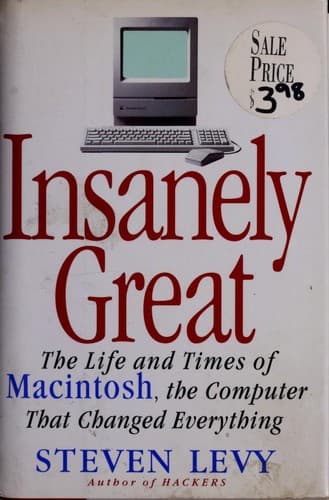
Insanely Great
by Steven Levy
Steven Levy's vivid 1994 account of how the Macintosh was built, drawn from the rebellious team behind it, still explains why Apple's design culture took shape.
What It's About
Insanely Great is Steven Levy's 1994 account of how the Macintosh got made, told mostly through the people who built it. Levy, a technology journalist, follows the project from its early days as a small, unusual effort inside Apple through its 1984 launch and the years that followed. The narrative leans on scenes: late-night coding, arguments over design, the team's proudly defiant identity, and the personalities pulling Steve Jobs and everyone else in different directions.
The style is brisk and anecdotal rather than analytical. Levy spends less time on engineering detail than on motives, egos, and a deadline that kept moving. Readers who know only the Jobs legend will find a messier, more collaborative story in which many engineers and designers shaped the product. It reads like a long magazine feature with the momentum of a thriller, and it keeps its attention on human stakes rather than explaining the technology.
It is best read as a snapshot of one moment in computing history, written by a reporter with close access to the team. The experience is entertaining and affectionate, with a clear sense that a small group believed they were making something that mattered.
Read this if you…
- want a behind-the-scenes look at how a famous product was made
- are curious about Apple's early years and the 1980s computer industry
- enjoy character-driven business history with a fast storytelling pace
Skip it if you…
- want technical detail on how the Macintosh's hardware and software actually worked
- need an up-to-date history of Apple, including its later comebacks and products
Key Ideas
- 1
A product built by a stubborn, defiant team
Levy's central subject is the group of engineers, designers, and programmers who worked on the Macintosh. Their shared sense of being outsiders inside a large company gives the project its energy. The book shows how that identity drove both their best work and their most exhausting habits, and why many of them felt the machine was a personal mission rather than just a job.
- 2
Jobs as catalyst rather than sole author
The popular story casts Jobs as the single visionary behind the Macintosh. Levy presents him as a powerful and often abrasive force who pushed, provoked, and redirected the team, but who depended on others for the actual invention. The book is useful for seeing where his influence mattered and where the credit belongs to people whose names are less familiar.
- 3
Design choices as arguments about values
Decisions about the interface, the mouse, the size and look of the machine, and how much users should be allowed to tinker are presented as disputes over what computers were for. Levy shows these choices as contested positions rather than obvious improvements. This makes the book a useful lens on why later consumer technology looks the way it does.
- 4
Ambition colliding with money and deadlines
The project ran against commercial pressure, shifting schedules, and internal rivalries. Levy shows how grand ambitions had to be cut, reshaped, or rushed to reach shelves. The result is a practical story about the gap between what a team imagines and what a company will fund and ship, which applies well beyond computing.
Limitations
The book is dated. It was written in 1994, so it stops well before Jobs returned to Apple in 1997 and long before the iPod, iPhone, and later products. Levy relies heavily on access to the team, which can make the account warmer toward its subjects than a more adversarial history would be. Engineering explanations are light, so readers wanting technical depth will need other sources. Some figures outside the core group receive only brief treatment.
Questions Readers Ask
- Is Insanely Great still worth reading today?
- Yes, as history. The Macintosh shaped personal computing, and Levy captures the mood and tensions of the project well. For the story after 1994, you will need other sources, since the book ends before Jobs's return to Apple and the company's later rise.
- How does it compare to Walter Isaacson's Steve Jobs?
- Isaacson's 2011 biography covers Jobs's whole life, with more on his personality and later career. Levy's book is narrower, focused on one product and the team around it, and gives more space to the engineers and designers. Read Levy for the Macintosh story in depth, and Isaacson for the larger portrait.
- Published
- 1994
- ISBN
- 9780140232370
- Difficulty
- beginner
- Category
- Tech
Book details and cover from Google Books.
Ready to read Insanely Great?
Get your copy on Amazon, or listen to it on Audible. We earn a commission if you buy through these links.