
We earn a commission if you buy through these links. Learn more
Infinite Jest
Guide by the Books of the Day editors · Updated · How we write our guides
David Foster Wallace's 1996 novel about tennis prodigies, addiction recovery, and a deadly addictive film. Who it suits and what to read instead.
What Creators Say About Infinite Jest
2 creators reviewed Infinite Jest on YouTube between 2015 and 2025, with 136.3K views between them. Their opinions are their own; we picked these reviews, we didn't write them.
What It's About
Infinite Jest is a 1996 novel of roughly a thousand pages, plus a large set of endnotes, set in a near-future North America where national borders have been folded into large political units and years are sold under corporate sponsor names. Its center is an elite tennis academy in Massachusetts run by a family whose patriarch, a filmmaker, is dead. Alongside it runs a recovery house in Boston for people struggling with addiction. A film called the Entertainment, so pleasurable that viewers lose interest in everything else, hovers over the story like a lethal object everyone is trying to find.
The approach is the thing readers talk about. Wallace moves among many viewpoints, time periods, and registers, from clinical precision to slangy monologue. The endnotes run for pages at a time and carry jokes, digressions, and actual plot. Reading it feels like trying to follow several conversations in a crowded room: you catch fragments first, then the pattern clicks and the book starts to reward your patience. The opening stretch is the hardest part.
Despite the Tech label, this is a novel rather than a book about gadgets. Technology is the backdrop; the real subject is attention, appetite, and how people try to escape themselves. It is funny, bleak, and often moving, and it asks for weeks of reading rather than a weekend.
Read this if you…
- enjoy long, difficult novels and will commit to a slow start
- like comedy and grief showing up in the same paragraph
- are interested in addiction, attention, and how modern life pulls at focus
Skip it if you…
- want a fast plot or a clear story you can follow without effort
- are mainly looking for technology speculation or gadget detail rather than character and language
Key Ideas
- 1
Entertainment as a form of addiction
The novel imagines pleasure so total that it hollows out the people who consume it. Wallace uses this premise to ask how much of modern life is built to capture attention and what that capture costs. The idea is less about gadgets than about the pull of anything that promises to make discomfort disappear, and it reads as more pointed now than when the book appeared.
- 2
Addiction and recovery as shared human condition
Much of the book's emotional weight sits in the halfway house, where residents with very different pasts meet in meetings and daily routines. Wallace treats recovery with unusual seriousness and humor, showing how people fight the same compulsions in different disguises. The portrayal is detailed and empathetic, and it gives the novel a steady counterweight to the frantic world of the academy.
- 3
Family, genius, and the pressure to excel
The Incandenza family sits at the center of the academy plot, and its members are brilliant, damaged, and often funny in their isolation. Wallace explores how talent can become a trap, how parents shape children through absence as much as presence, and how ambition can leave people unable to connect. These relationships give the sprawling plot a human anchor.
- 4
Form that mirrors a restless mind
The structure is part of the argument. Nonlinear timelines, many narrators, and the endnote system force the reader to hold multiple threads at once, which mirrors the scattered attention the book describes. Some readers find this exhausting, but others find that the difficulty makes the eventual payoffs feel earned, and that the form itself becomes one of the book's pleasures.
Limitations
The novel is long and dense, and its opening chapters ask a lot before rewarding you. The endnote system splits attention and can feel like a gimmick to some readers. Critics have also pointed to uneven treatment of its female characters and to subplots, such as the Quebec separatist storyline, that some find less developed than the rest. Its near-future technology, including cartridges and videophones, now looks dated, though much of its concern with screens and compulsion has aged well.
Questions Readers Ask
- Is Infinite Jest still worth reading with streaming and smartphones?
- Yes. The specific gadgets feel quaint, but the book's concerns about compulsive entertainment, distraction, and escape have arguably become more relevant. Most readers find the characters and the book's sense of humor and grief carry it well beyond its technology.
- Do I need to read the endnotes?
- Many of them matter. Some carry plot, backstory, or important jokes, so skipping them entirely means missing things. Many readers flip back and forth as they go, while others save a second pass for the notes once the main text is familiar.
- Is it like Gravity's Rainbow?
- Both are long, allusive, and encyclopedic novels that reward patience. Pynchon is more paranoid and historically dense, while Wallace is more emotionally direct and funnier about loneliness, addiction, and family. If you liked Pynchon's appetite for sprawl, you will likely find Wallace rewarding.
- Published
- 1996
- ISBN
- 9780349121086
- Difficulty
- advanced
- Category
- Tech
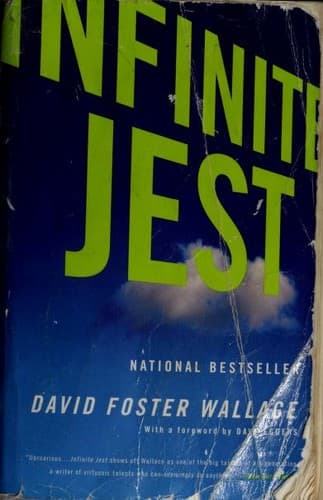
Book details and cover from Google Books.
Ready to read Infinite Jest?
Get your copy on Amazon, or listen to it on Audible. We earn a commission if you buy through these links.