
We earn a commission if you buy through these links. Learn more
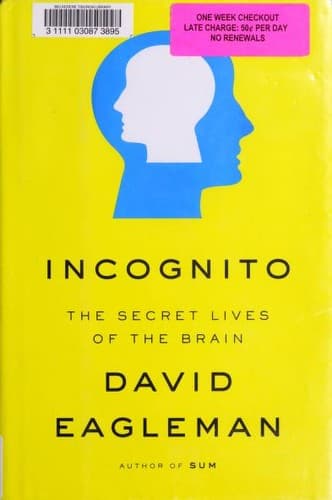
Incognito
A readable tour of how much of your mind runs without you, from perception and memory to decisions and responsibility, told through vivid case studies by a working neuroscientist.
What It's About
Incognito is David Eagleman's popular account of the brain's hidden machinery. His central claim is that the conscious self, the part that feels like it is in charge, sees only a small slice of what the brain does. Most perception, movement, memory and judgment happen in subsystems that run below awareness, and the self mostly receives their results after the fact. Eagleman, a neuroscientist, builds this case from laboratory findings, clinical cases and surprising examples of people whose brains behaved in unexpected ways.
The style is conversational and brisk. Chapters are short, the tone is curious rather than preachy, and Eagleman leans on vivid stories and thought experiments to make abstract ideas tangible. You will not need a background in neuroscience, though you should expect some technical vocabulary and a steady stream of examples rather than long theoretical argument. The book reads more like a guided walk through a museum of brain oddities than a single sustained thesis.
Reading it is less about memorizing facts than about shifting how you think about your own mind. Many readers come away questioning how much they really decide, how reliable their senses are, and how society should think about blame when behavior has biological roots. Those are big questions, and Eagleman raises them more than he settles them, so the experience is best described as provocative and engaging rather than conclusive.
Read this if you…
- are curious about how perception and decision-making actually work
- want a gentle, nonspecialist entry point into neuroscience
- are interested in what brain science means for free will and responsibility
Skip it if you…
- want a rigorous, detailed treatment of a single brain system or a textbook-style survey
- prefer sustained philosophical argument over anecdotes and illustrative stories
Key Ideas
- 1
Much of the brain operates beneath awareness
Eagleman argues that the brain runs many processes in parallel, mostly unconsciously, handling things like balance, reaching for objects and habit. Conscious attention is a narrow spotlight. The conscious self is better understood as a spokesperson that explains decisions largely made elsewhere, which changes how much weight you give your own sense of control.
- 2
The brain as a team of rivals
Rather than a single controller issuing orders, the brain is a collection of specialized, sometimes competing subsystems that negotiate with one another. Behavior emerges from this negotiation. The model helps explain contradictory impulses and the familiar feeling of being divided against yourself.
- 3
Perception is a construction, not a recording
The senses deliver incomplete and noisy signals, and the brain fills gaps, predicts what should happen and builds a working model of the world. Illusions and blind spots serve as evidence that what you experience is an interpretation. This idea reframes how you think about seeing, hearing and remembering.
- 4
Free will and responsibility under scrutiny
If decisions have biological causes, what does that mean for blame and punishment? Eagleman uses cases where behavior changed after injury or disease to explore this question. He suggests that legal and social thinking may need to account for brain differences, while leaving the hardest philosophical issues open.
Limitations
Critics note that the book's breadth comes at a cost: the case studies are illustrative rather than systematically tested, and some claims about free will and legal responsibility are more speculative than the confident tone suggests. Because neuroscience has moved quickly since the book appeared, some specifics may be dated, so check current research on memory, consciousness and plasticity before relying on particular details. It also does not engage deeply with the philosophical debate about consciousness, and it is an overview rather than a practical guide.
Questions Readers Ask
- Is Incognito still worth reading given how fast neuroscience moves?
- Yes, mostly for its framework rather than its specific findings. The central idea that much of mental life runs unconsciously is well established and remains a useful lens. Some particular experiments and examples may have been refined or revised since the book was published, so treat it as a starting point and verify any claim you plan to rely on.
- How does it compare with other popular books about the unconscious mind?
- Incognito works more like a tour of case studies than a single tightly argued thesis. If you want a structured case about how judgment goes wrong, a book focused on decision-making biases may suit you better. If you want the brain's inner workings explained through strange and memorable examples, this is a good fit.
- Published
- 2011
- ISBN
- 9780307377333
- Difficulty
- beginner
- Category
- Science
Book details and cover from Google Books.
Ready to read Incognito?
Get your copy on Amazon, or listen to it on Audible. We earn a commission if you buy through these links.