
We earn a commission if you buy through these links. Learn more
In the Night Kitchen
Guide by the Books of the Day editors · Updated · How we write our guides
A small boy tumbles out of bed into a midnight bakery in this short, strange, visually inventive picture book that rewards adults as much as children.
What Creators Say About In the Night Kitchen
2 creators reviewed In the Night Kitchen on YouTube between 2014 and 2015, with 130K views between them. Their opinions are their own; we picked these reviews, we didn't write them.
What It's About
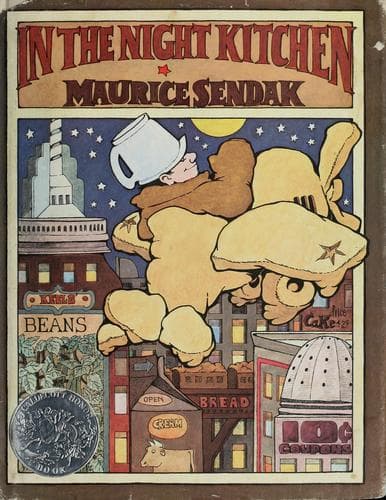
In the Night Kitchen is a short picture book about a small boy named Mickey who is woken by a noise in the middle of the night, tumbles out of bed, and finds himself in a bright, busy kitchen where three bakers are preparing the morning cake. The story is brief enough to read in a few minutes, but most of its work happens in the pictures. Sendak fills his pages with dense detail, so that Mickey's nighttime world feels both ordinary and enormous, as if everyday objects like milk, dough, and machinery have become part of a dream.
The text is sparse, made mostly of short lines and sounds that read aloud like a chant. The panels are arranged in a comic-strip grid that borrows from early twentieth-century strips such as Winsor McCay's Little Nemo. Mickey is drawn without clothes for much of the book, which accounts for a good deal of its controversy and for the challenges it has faced in some libraries.
Reading it feels quick, playful, and a little unsettling. Children tend to take it as an adventure, while adults often notice more on a second or third pass, especially the way it treats bedtime, the fear of the dark, and the process of growing up. The reading time is short, but the pleasure lies in lingering over each frame.
Read this if you…
- Want a picture book that rewards close looking and repeated readings
- Are interested in how illustration can carry a story almost on its own
- Enjoy dreamlike, slightly surreal children's books with a sense of mischief
Skip it if you…
- Want a clear, reassuring bedtime story with a tidy moral
- Are looking for a long narrative with plot, characters, and detailed explanation
Key Ideas
- 1
Dreams as a place of play and risk
The book treats the night as a space where ordinary rules loosen. Mickey's fall into the kitchen is both thrilling and frightening, and the story lets a child's sense of adventure and vulnerability sit side by side without resolving the tension into a simple lesson.
- 2
Pictures carry most of the storytelling
With very little text, the illustrations do the real narrative work. Readers have to follow Mickey's movements across the page and piece together what is happening, which makes the book feel more like a visual puzzle than a read-aloud story.
- 3
Comic-strip form as a deliberate homage
The grid layout and the rhythm of panels recall early comic strips and their dreamlike worlds. Sendak uses that tradition to give a bedtime story the energy and structure of a sequence of bold, self-contained scenes.
- 4
Nudity, innocence, and the body
Mickey's nakedness is central to how the book is read. Some see it as an honest picture of childhood, while others find it provocative. Either way, it raises questions about how adults decide what children's books may show and what they should be protected from.
- 5
Everyday routines made strange
Baking, milk, and bedtime are familiar to young readers, and the book makes them unfamiliar. That shift lets children see household routines as mysterious and worth examining, and gives adults a playful way to revisit their own childhood fears.
Limitations
The book is very short, so readers who want a developed plot or deep characterization may find it slight. Its dreamlike logic and visual strangeness can unsettle some young children, and the nudity has led many parents and libraries to object or restrict access. Some readers also find its ending open to multiple readings, which can feel either rich or unsatisfying depending on expectations. Its strong comic-strip style is distinctive, but it reflects mid-century picture-book conventions that not every reader will find fresh.
Questions Readers Ask
- Is In the Night Kitchen suitable for young children?
- Many families read it with children from about three or four upward, but parents should know the nudity and the dreamlike, sometimes startling imagery before sharing it. Reading it together lets adults talk through what is happening and answer questions about the strange scenes, which often works better than handing it over without comment.
- Is In the Night Kitchen still worth reading today?
- Yes, especially for adults interested in picture books as art. Sendak's layouts and his comic-strip influences still look distinctive, and the book remains widely taught and discussed. Its treatment of nighttime fear and growing up feels as relevant now as when it first appeared.
- How does it compare to Where the Wild Things Are?
- Both are by Maurice Sendak and both take a child's imaginative journey through the night. Where the Wild Things Are has a more structured emotional arc and a larger sense of escape, while In the Night Kitchen is more compact, more visually experimental, and more likely to provoke discomfort.
- Published
- 1889
- ISBN
- 9789999921008
- Difficulty
- beginner
- Category
- Fantasy
Book details and cover from Google Books.
Ready to read In the Night Kitchen?
Get your copy on Amazon, or listen to it on Audible. We earn a commission if you buy through these links.