
We earn a commission if you buy through these links. Learn more
If You Give a Mouse a Cookie
A boy's one small kindness sets off a comic chain of escalating requests, and its tight cause-and-effect rhythm makes it a near-perfect read-aloud for children roughly three to seven.
What It's About
If You Give a Mouse a Cookie is a short picture book about a mouse who receives a cookie and, one reasonable-sounding request at a time, sets off a long string of demands on the household that sheltered him. Each new want grows out of the last one, so the story moves like a line of dominoes. Readers who expect a plot with a conflict and resolution will find something lighter: the pleasure is in watching the chain grow and guessing where it will go next.
The text is spare and rhythmic, built on a repeated pattern of if-then cause and effect. Much of the humor sits in the illustrations by Felicia Bond, which add details and small reactions the words never mention, so a reader who lingers over each page will notice more than a reader who hurries. The experience is brisk and playful. It is designed to be read aloud, with pauses and a sing-song beat that invites children to chime in before the next request arrives.
For adult readers, the book is a quick exercise in comic logic and a gentle reminder of how a single favor can balloon into a full afternoon of chores. It takes only minutes to finish, and its appeal lies mostly in pacing and in the way its humor accumulates page by page.
Read this if you…
- want a quick, funny read-aloud for young children
- are interested in how simple picture books build humor through repetition and pacing
- enjoy a light story where the fun is in the escalation rather than the plot
Skip it if you…
- are looking for a story with real conflict, character growth, or emotional depth
- want a book for older readers rather than a very young audience
Key Ideas
- 1
A chain reaction built on cause and effect
Each request follows from the one before, so the story teaches children to follow a sequence of consequences. The logic is simple, but the escalation is what keeps the book moving. Adults may notice how cleanly the structure works, with no request feeling random.
- 2
Pacing designed for reading aloud
The sentences are short and repetitive, which gives the book a steady beat that suits a parent's voice. The repetition also lets young listeners predict what comes next, which turns reading into a small game. That predictability is a big part of why the book holds up with very young audiences.
- 3
Illustrations that carry half the joke
Felicia Bond's pictures add visual humor and small emotional beats that the text leaves out. Reading the pictures closely rewards a second or third pass. The text and art work as a pair, and the book is funnier when both are read together.
- 4
Gentle comedy about hosting and children's logic
The humor comes from taking a child's way of thinking seriously: one want leads naturally to another. Many adults will recognize the feeling of agreeing to one small favor and ending up with a long list. The tone stays warm rather than sharp, so the joke lands without anyone being mocked.
- 5
A circular structure that closes the loop
The story is built to return to its starting point rather than end in a resolution. Some readers find this satisfying as a bit of storytelling craft, while others may find it abrupt. Either way, the shape is the point, and it is a good example of how picture books can play with form.
Limitations
The book is slight by design. It has no real conflict, little character development, and an open, circular ending that some readers find unsatisfying. Adults looking for depth will likely finish it quickly and feel it offers little beyond its premise. Its humor relies on a familiar scenario, so readers who already know the concept may find the surprise faded. It is best judged as a small, playful picture book rather than a substantial story.
Questions Readers Ask
- Who is If You Give a Mouse a Cookie best for?
- It suits young children, roughly preschool through early elementary, and the parents or teachers who read to them. It works especially well as a read-aloud because the repetition and rhythm invite participation. Older readers can enjoy it as a quick, light read, but it is not designed to hold their attention for long.
- Is the book still worth reading today?
- Yes, for its purpose. The cause-and-effect structure is timeless and the humor still works with children today. Its appeal has not depended on references that date it, so it remains a common choice for early readers and bedtime reading.
- How does it compare to other cumulative picture books?
- Many cumulative picture books, such as those that build a list or a chain one item at a time, share this structure. This one stands out for its tight if-then logic and its humor, which depends on the escalation of small requests. Readers who like the format may enjoy the rest of the same series by the same author.
- Published
- 1985
- ISBN
- 9780060254384
- Difficulty
- beginner
- Category
- Fiction
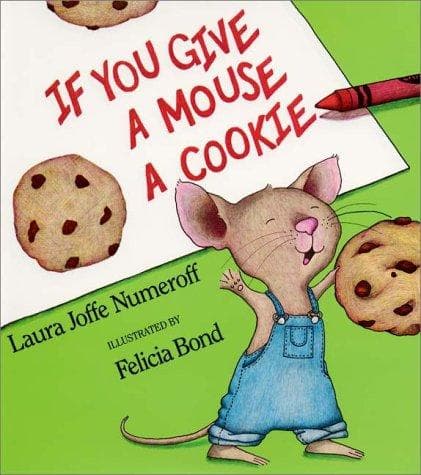
Book details and cover from Google Books.
Ready to read If You Give a Mouse a Cookie?
Get your copy on Amazon, or listen to it on Audible. We earn a commission if you buy through these links.