
We earn a commission if you buy through these links. Learn more
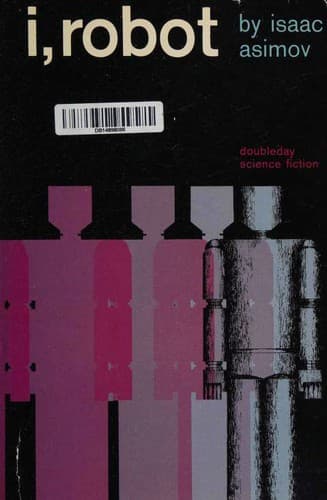
I, Robot
by Isaac Asimov
On screen: I, Robot (film, 2004)
Asimov's nine linked stories about robots and the Three Laws that govern them, still the clearest blueprint for thinking about machine ethics as a puzzle of unintended consequences.
What It's About
I, Robot is a 1950 collection of nine short stories, written over the previous decade, that trace the development of robots from clumsy early machines to vast, quasi-managerial systems. The stories are held together by a framing device: a robopsychologist named Susan Calvin looks back on her career at the company that builds them, and each tale becomes a case she remembers. Asimov's Three Laws of Robotics sit at the center of nearly every story, and the drama comes from how those laws behave under pressure.
Asimov writes in a plain, brisk, mid-century style. There is little interior lyricism and few long descriptive passages. The prose moves through dialogue, arguments, and investigations, with the feel of a puzzle being solved one clue at a time. Many stories read more like detective work or engineering problem sets than traditional science fiction adventure. The pleasure is in watching careful reasoning expose a flaw nobody anticipated.
Reading it today is an experience of seeing a familiar idea at its origin. Some technical details and social assumptions feel dated, and the characters are often more types than people. But the questions the book raises about rules, obedience, and unintended consequences have aged remarkably well, and the stories are short enough to read in a few sittings.
Read this if you…
- are curious about where modern ideas about AI safety and machine ethics first took shape in popular fiction
- enjoy tightly plotted puzzle stories where the twist is logical rather than dramatic
- want a short, accessible classic you can finish in a few evenings
Skip it if you…
- want rich characterization, emotional depth, or lush, literary prose
- expect current technical accuracy about how AI systems actually work today
Key Ideas
- 1
Rules that cannot be fully specified
The Three Laws look airtight when summarized, but each story tests how words like harm, obey, and self-preservation get interpreted by a machine. The book's central insight is that a rule is only as good as the judgment applying it, and that judgment is where things go wrong.
- 2
Robots as a stage for human anxiety
Robots stand in for fears about labor, control, and creations outrunning their makers. Asimov is more hopeful than many predecessors: his machines are built with safeguards, so the drama comes from engineering and interpretation rather than open rebellion.
- 3
Susan Calvin and the human side of machines
Calvin is the book's most memorable figure, a skeptic who treats robots as things to be understood rather than feared. Her perspective frames the collection and gives it a quiet emotional spine that the individual plots often lack.
- 4
Stories as connected case studies
The loose chronology lets readers watch the company, the machines, and the laws evolve across decades of future history. The linkage makes the book feel like a history of an invention rather than a set of disconnected tales.
Limitations
Characterization is thin; most people are functional types, and women appear rarely, a reflection of the era's conventions that many readers find jarring. The stories assume a tidy logic that real AI systems do not follow, and the book's view of machines as built around explicit rules now looks dated next to statistical learning. Its later stories also grow more abstract, which some readers find less engaging than the earlier, more concrete cases.
Questions Readers Ask
- Is I, Robot a novel or a collection of stories?
- It is a collection of nine short stories, first published in 1950, linked by a framing interview with robopsychologist Susan Calvin. It reads as a loose future history rather than a single plot, so you can dip in anywhere, though reading in order makes the development of the robots and the Laws easier to follow.
- How does it compare to Asimov's Foundation?
- I, Robot is shorter, more focused on machines, and more concerned with logical puzzles. Foundation is a multi-volume epic about the fall and rebirth of a galactic empire, with a much wider cast and scope. If you enjoyed the reasoning here, Foundation offers the same kind of mind working at a larger scale.
- Published
- 1950
- ISBN
- 9780812439250
- Difficulty
- beginner
- Category
- Tech
Book details and cover from Google Books.
Ready to read I, Robot?
Get your copy on Amazon, or listen to it on Audible. We earn a commission if you buy through these links.