
We earn a commission if you buy through these links. Learn more
I Know Why the Caged Bird Sings
by Maya Angelou
Guide by the Books of the Day editors · Updated · How we write our guides
Angelou's lyrical, unflinching 1969 memoir of a Black girl's childhood in the segregated South, where hard truths sit beside real tenderness and humor.
What Creators Say About I Know Why the Caged Bird Sings
2 creators reviewed I Know Why the Caged Bird Sings on YouTube between 2017 and 2020, with 104K views between them. Their opinions are their own; we picked these reviews, we didn't write them.
What It's About
I Know Why the Caged Bird Sings is the first of Maya Angelou's seven autobiographies, and it covers roughly the first sixteen years of her life. Much of it takes place in Stamps, Arkansas, where she is raised by her grandmother, who runs the town's general store, along with her brother Bailey. The book moves between that small world and the cities where her mother lives and works, and it ends at the birth of a son while Angelou is still a teenager.
Angelou writes in a voice closer to storytelling than reportage. Sentences are long and rhythmic, scenes are built with close attention to sound and gesture, and the prose often shifts into something near poetry. She draws on the books she read as a child, from Shakespeare to Paul Laurence Dunbar, and the title itself comes from a Dunbar poem. The memoir is arranged as a series of vivid episodes rather than a tidy timeline, so you feel the child's sense of the world instead of an adult summarizing it.
Reading it is an emotional experience. The book does not look away from racism, poverty, or sexual violence, including an assault in childhood that leads her to stop speaking for years. It is also funny and warm in places, especially in its portraits of family and community. Expect to finish it feeling you have spent time with someone, not simply learned facts about them.
Read this if you…
- want a classic of American memoir about childhood and race
- are drawn to lyrical, poetic prose that reads almost like verse
- want to understand Angelou's voice before reading her later books
Skip it if you…
- need a fast, plot-driven read
- want a light memoir without painful or graphic content
Key Ideas
- 1
Silence as a response to trauma
Angelou's childhood silence after an assault is the book's central thread. It is less about the event itself than about what a child does with an experience she cannot speak about, and how the adults around her respond. Her grandmother's care and the community's reading of her silence shape much of the story that follows.
- 2
Words as a way out
Books, memorization, poetry, and public recitation give the young narrator a language to make sense of a world that tries to define her. Angelou treats reading as both refuge and power, and she insists that literature belongs to her even when schools and white society suggest otherwise.
- 3
Race and class in a small Southern town
The memoir shows how segregation works in daily life: rules about where Black people can shop, how white people address them, and how Black families build their own institutions and dignity within those limits. The economic realities are never far from the surface.
- 4
Family as both wound and shelter
Her relationships with her mother, grandmother, and brother are complicated. The book refuses to sentimentalize them. Love and abandonment exist side by side, and the sense of belonging she finally finds has to be earned through difficult years.
Limitations
Some readers find the style dense or overwrought, especially in the longer, more ornate passages. The book covers only her childhood and adolescence, so her adult career, activism, and later writing appear in the subsequent volumes. Her perspective is necessarily personal and local, with little on the wider civil rights movement. Because of its frank depiction of sexual violence, it has also been challenged in some school districts, which is worth knowing if you are choosing it for a classroom or a young reader.
Questions Readers Ask
- Is I Know Why the Caged Bird Sings suitable for teenagers?
- It is widely taught in high schools and many students read it at fifteen or sixteen. However, it contains explicit descriptions of child rape and other sexual violence. Parents and teachers should know that before assigning it, and it can be worth reading alongside a young person so you can talk about the hardest passages.
- Should I read it before Angelou's other memoirs?
- Yes, it is the natural starting point. The later volumes continue her story into adulthood, and this first book gives you the family background and the origins of her voice. Each stands on its own, but reading them in order gives the fullest picture of her life.
- Published
- 1969
- ISBN
- 9780748122349
- Difficulty
- beginner
- Category
- Biographies
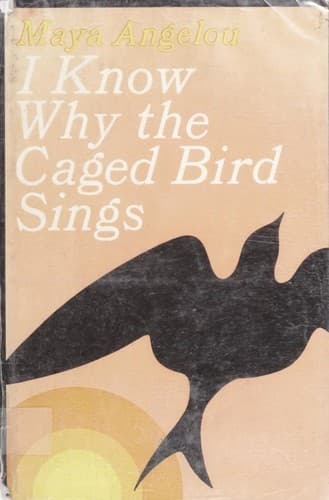
Book details and cover from Google Books.
Ready to read I Know Why the Caged Bird Sings?
Get your copy on Amazon, or listen to it on Audible. We earn a commission if you buy through these links.