
We earn a commission if you buy through these links. Learn more
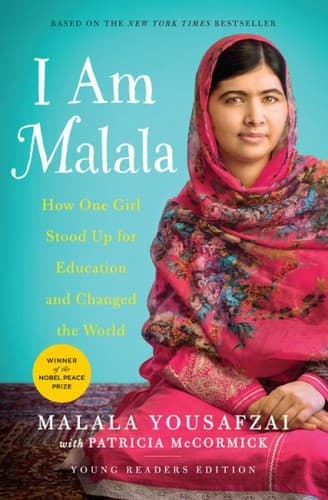
I am Malala
by Malala Yousafzai, Christina Lamb
Guide by the Books of the Day editors · Updated · How we write our guides
A teenager's firsthand account of defying the Taliban to get an education, and of the attack that made her a global symbol. Worth reading for its clarity and courage.
What Creators Say About I am Malala
2 creators reviewed I am Malala on YouTube between 2023 and 2025, with 119 views between them. Their opinions are their own; we picked these reviews, we didn't write them.
What It's About
I Am Malala is a memoir written with the British journalist Christina Lamb, and it tells the story of Malala Yousafzai's childhood in the Swat Valley, a green, mountainous region in northwest Pakistan. Malala grew up in a family that valued learning. Her father ran a school in the town of Mingora, and she was raised to see education as ordinary rather than a privilege. The book traces how that world changed as the Taliban moved into the valley, closing girls' schools, banning music, and turning public life into something frightening.
The book is written in a plain, direct voice that suits its subject. Malala explains local customs, family relationships, and the politics of the region for readers who may know little about Pakistan, and she doesn't pretend to be older or more worldly than she was. Some passages are slower and more detailed than you might expect, while the account of the day she was shot on her school bus is told with restraint rather than sensationalism. Lamb's role shows in the clear structure and the context wrapped around Malala's own words.
Reading it is less like following a thriller than listening to someone explain how ordinary life became dangerous. The emotional weight builds gradually, and the hospital and recovery sections give a sense of how much the aftermath involved: her family, the medical teams, and the new public role that followed. Expect a book that is partly testimony and partly an argument for girls' education, with the personal and political woven together.
Read this if you…
- want a firsthand look at life under Taliban rule in Pakistan
- are interested in why girls' education remains a contested issue
- prefer a personal story to a detailed policy analysis
Skip it if you…
- want a detailed history of Pakistan or the Taliban movement
- are looking for a dense, critical political analysis rather than a personal account
Key Ideas
- 1
Education as an ordinary right, not a privilege
Malala presents schooling as something her family took for granted, and the book shows how quickly that assumption became a dangerous position once the Taliban restricted girls' access. Watching that shift happen is the emotional and intellectual core of the book, and it explains why she came to see schooling as a basic claim rather than a favor.
- 2
How extremism reshapes everyday life
The memoir shows Taliban rule less through battles than through small restrictions: closed schools, banned activities, and a constant sense of fear in markets, homes, and public spaces. It is a useful account of how a community adjusts, and sometimes resists, when violence becomes routine rather than exceptional.
- 3
A teenager's voice inside a political story
Malala's perspective is personal rather than analytical, and she is candid about her own fear, pride, and occasional confusion. That gives readers a view of Pakistan's conflict from inside a family and a school, rather than from a policy desk or a battlefield, which makes the stakes easier to feel.
- 4
Survival, recovery, and the cost of fame
The later sections cover the attack, treatment abroad, and the pressures of becoming an international figure. The book is honest that visibility brought support but also strain on her family and on her sense of who she was, and that recovery was as much emotional as physical.
Limitations
The book is a memoir, so it reflects one family's perspective and Malala's account of events she witnessed or heard about. Readers looking for an independent history of the Swat conflict will need other sources. Some readers and commentators have argued that the story is shaped for a Western audience and simplifies Pakistan's political complexities. Because it was written while she was still a teenager, it lacks the reflective distance a later memoir might offer.
Questions Readers Ask
- Is I Am Malala suitable for teenagers?
- Yes, it is widely read by younger readers and is written in clear, direct prose. Some passages describe violence, including the attack on her and threats to her family, so parents of younger readers may want to know that before handing it over. It also works well for adults who have read little about Pakistan.
- What should I read after I Am Malala?
- If the political side interests you most, try Azar Nafisi's Reading Lolita in Tehran, a memoir of women's lives under a repressive regime, though it is set in Iran and written with a literary focus. For an accessible look at Pakistan's history, look for a general history of the country written by a Pakistani historian.
- Published
- 2012
- ISBN
- 9783596812530
- Difficulty
- beginner
- Category
- Education
Book details and cover from Google Books.
Ready to read I am Malala?
Get your copy on Amazon, or listen to it on Audible. We earn a commission if you buy through these links.