
We earn a commission if you buy through these links. Learn more
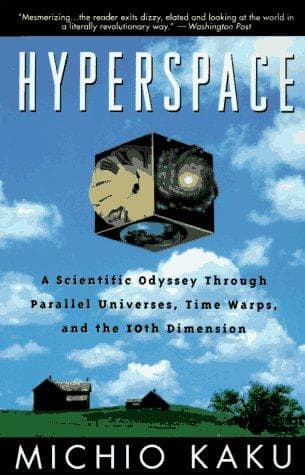
Hyperspace
by Michio Kaku
Guide by the Books of the Day editors · Updated · How we write our guides
A 1994 physicist's tour of extra dimensions, string theory and exotic physics, worth reading for its enthusiasm and its history, though much of its frontier has since moved on.
What Creators Say About Hyperspace
2 creators reviewed Hyperspace on YouTube between 2019 and 2023, with 4.1K views between them. Their opinions are their own; we picked these reviews, we didn't write them.
What It's About
Hyperspace is a 1994 popular science book by theoretical physicist Michio Kaku. Its central subject is the idea that space may have more dimensions than the three we experience, and that these hidden dimensions could explain why gravity behaves so differently from the other forces of nature. Kaku uses this idea as a thread to connect Einstein's unfinished search for a unified theory with the string theory that physicists were actively developing when he wrote the book.
The approach is that of a guide rather than a lecturer. Kaku relies on analogies and thought experiments to help readers picture curled-up dimensions and the tiny scales where quantum effects and gravity meet. He moves between well-established physics and open speculation, including black holes, wormholes, time travel and parallel universes, and he tends to signal which claims rest on firm footing and which are conjecture. The tone is energetic and conversational, with plenty of anecdotes about the physicists involved.
Reading it is less like studying a textbook and more like listening to a passionate expert describe a frontier. The math stays light, but the ideas come quickly, and the later chapters on string theory demand close attention. The result is a book that feels vivid and ambitious, and that is part of its charm and part of its problem.
Read this if you…
- are curious how physicists think about extra dimensions and want a friendly first introduction
- want a sense of the history behind string theory and Einstein's unfinished quest for a unified theory
- enjoy big, speculative ideas and don't mind a book whose predictions have partly been overtaken by events
Skip it if you…
- want an up-to-date account of current research on string theory, M-theory or brane worlds
- prefer cautious, evidence-first writing that keeps speculation clearly separated from established results
Key Ideas
- 1
Extra dimensions as a way to unify forces
Kaku traces the older idea that adding a hidden dimension might merge electromagnetism with gravity. He shows how a dimension rolled up too small to see could, in principle, account for the forces we observe. This is the conceptual backbone that makes the rest of the book hang together, and it is explained more clearly than in many later popular accounts.
- 2
String theory as a candidate framework
Instead of point particles, string theory proposes that the fundamental building blocks are tiny vibrating strings, with different vibration patterns corresponding to different particles. Kaku presents this as the most promising route to a theory of quantum gravity, while being candid that the theory was mathematically ambitious and had no experimental confirmation at the time.
- 3
The Planck scale and the limits of testing
A recurring theme is how far beyond current particle accelerators the relevant energies lie. Kaku explains why physicists struggle to test their ideas directly and why mathematical consistency often has to do the work that experiments cannot. This gives readers a useful sense of what separates a good theory from a merely appealing one.
- 4
Black holes, wormholes and time travel
Kaku explores exotic objects that general relativity allows, such as wormholes and the possibility of time travel. He treats these as serious theoretical questions rather than science fiction, which makes for lively reading. The reader should keep in mind that these ideas remain speculative and were never observed.
- 5
Parallel universes and the idea of a multiverse
The book ends by considering whether our universe could be one of many, possibly separated by higher dimensions. Kaku's discussion is provocative and open-ended. It is most valuable as a snapshot of how physicists were thinking about these questions in the mid-1990s.
Limitations
The book is dated. It was written before the later developments in M-theory and brane-world models that reshaped the field, so its picture of the state of research is incomplete. Some critics find Kaku's enthusiasm leads him to present speculative ideas, such as time travel and parallel universes, with more confidence than the evidence supports. The string theory material is also difficult to verify, and the book does not explain why later researchers came to see some of these approaches as dead ends.
Questions Readers Ask
- Is Hyperspace still worth reading today?
- Yes, if you want an enthusiastic introduction to the ideas behind extra dimensions and early string theory. Its core concepts remain sound. However, the research landscape has changed a great deal since 1994, so pair it with a more recent book if you want to know where physicists stand now.
- How does Hyperspace compare to The Elegant Universe?
- Brian Greene's The Elegant Universe is more systematic and more current on string theory, and it is often easier to follow step by step. Hyperspace is more personal and more speculative, with a stronger sense of physics as an adventure. Reading both gives a fuller picture.
- Do I need a physics background to read it?
- No. The book is written for general readers and relies on analogies rather than heavy mathematics. A basic familiarity with relativity and quantum mechanics helps, but a curious reader with patience can follow the main arguments.
- Published
- 1994
- ISBN
- 9780195085143
- Difficulty
- intermediate
- Category
- Science
Book details and cover from Google Books.
Ready to read Hyperspace?
Get your copy on Amazon, or listen to it on Audible. We earn a commission if you buy through these links.