
We earn a commission if you buy through these links. Learn more
Hyperbole and a Half
by Allie Brosh
Guide by the Books of the Day editors · Updated · How we write our guides
A funny, honest illustrated memoir where crude drawings and exaggerated stories carry real feeling about childhood, pets, and depression, so it's worth reading in one sitting.
What Creators Say About Hyperbole and a Half
2 creators reviewed Hyperbole and a Half on YouTube between 2014 and 2015, with 4.5K views between them. Their opinions are their own; we picked these reviews, we didn't write them.
What It's About
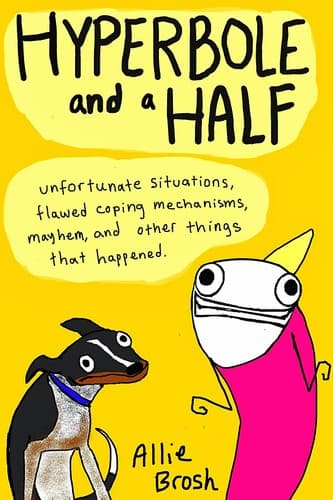
Hyperbole and a Half collects the illustrated stories Allie Brosh first published on her blog, expanded for print. Although this listing files it under fiction, it is a memoir in comic form. The stories draw on her childhood, her relationship with her dogs, and her experience of depression. The drawings are deliberately crude, made in simple paint software with stick figures and blocky shapes, and that roughness is part of the joke.
The method is to take an ordinary moment, like a bad morning, a stubborn animal, or a dull errand, and stretch it until the feeling behind it is impossible to miss. Brosh's narrator often takes her own logic very seriously, and the comedy comes from how earnestly she commits to a bad plan. Short captions and quick panels set the rhythm, so the book reads fast and rewards slowing down at the moments where the tone shifts.
The experience changes as you go. Early pieces are mostly light and silly, while later ones turn toward something heavier and more direct. Reading it feels like being let in on a close friend's private jokes, and then being asked to sit with something painful without being told how to feel about it.
Read this if you…
- enjoy dry, self-deprecating humor that finds comedy in everyday frustration
- want a memoir about mental health that is funny without being glib
- like picture-driven books you can finish in an evening
Skip it if you…
- need a clinical or practical guide to depression, since this is a personal story rather than advice
- dislike simple, deliberately rough drawings and prefer polished illustration
Key Ideas
- 1
Exaggeration as a way to tell the truth
Brosh stretches small events into absurd scenarios, and the distortion is the point. The exaggeration captures how a minor frustration can feel enormous from the inside. Readers often recognize their own overreactions in the narrator, which makes the jokes land as shared experience rather than mockery.
- 2
Childhood logic and the unfairness of rules
Many stories revisit the way children reason about rules, consequences, and authority. The narrator's conclusions are wrong in ways that are obvious to adults, yet her reasoning is internally consistent. The book suggests that much of growing up is learning which of your certainties were never real.
- 3
Depression described from the inside
The later material describes depression through the same plain, exaggerated style, which makes its heaviness hit harder. Rather than explaining the condition clinically, Brosh shows how it distorts ordinary tasks and thoughts. It is a personal account, not a guide, but many readers find it clarifying.
- 4
Self-deprecation that stays kind
The narrator mocks her own failures constantly, but the humor rarely turns cynical. There is a steady warmth toward the people and animals in the stories, including the narrator herself. That generosity is a large part of why the book feels comforting even when it is sad.
Limitations
The drawings are intentionally crude, and some readers find the style wearing over a full book. The collection is uneven: a few pieces are slighter than the rest, and the most affecting material arrives later, which can make the first half feel lighter than it is. The book is also a single personal account, so it does not represent the experience of depression in general, and it offers no treatment guidance. Its humor depends heavily on the blog-era internet culture it grew from, which may read as dated to some.
Questions Readers Ask
- Is Hyperbole and a Half fiction?
- No. Despite how it is categorized here, it is a memoir told in comic form. The stories are based on Allie Brosh's own childhood, animals, and experiences, and they are presented as personal recollections, drawn in an intentionally simple style.
- Do I need to know the original blog to enjoy the book?
- No. The book collects and expands the blog pieces, and new readers can follow every story without prior context. Some readers who knew the blog say the print version adds material and tightens the sequence, but it works as a standalone read.
- How does it compare to other illustrated memoirs?
- It is lighter and more absurd than most illustrated memoirs, with a deliberately crude art style rather than polished drawing. Readers who like Lucy Knisley's or Alison Bechdel's work may find the emotional honesty familiar, though Brosh's tone is looser and more comedic.
- Published
- 1900
- ISBN
- 9781476764597
- Difficulty
- beginner
- Category
- Fiction
Book details and cover from Google Books.
Ready to read Hyperbole and a Half?
Get your copy on Amazon, or listen to it on Audible. We earn a commission if you buy through these links.