
We earn a commission if you buy through these links. Learn more
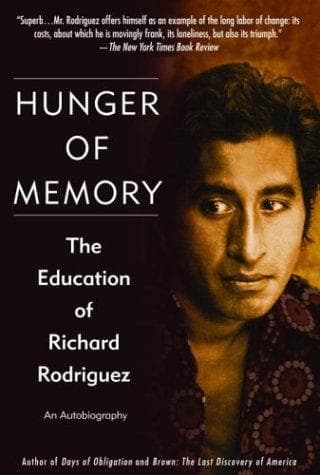
Hunger of memory
A candid, carefully argued memoir of how learning English at school reshaped a Mexican-American boy's relationship with his family, and why that trade still provokes debate about language, identity, and belonging.
What It's About
Hunger of Memory (1982) is an autobiographical book, subtitled The Education of Richard Rodriguez. It follows a boy raised in a Spanish-speaking, Mexican-American household in Sacramento, who arrives at school knowing little English and is gradually shaped by teachers, nuns, and books into someone who feels distant from the home he grew up in.
Rodriguez tells this as a series of linked essays rather than a straight narrative. His style is formal, reflective, and often lyrical. He reads his own childhood almost like a literary critic, pausing over words, the difference between public and private speech, and what intimacy sounds like. The experience is intimate and argumentative at once. It moves slowly, and you can feel a man working out what he owes to home and what he gained elsewhere.
Expect a book that argues as much as it remembers. Rodriguez takes firm positions on bilingual education and affirmative action, which made the book controversial when it appeared, and he is more interested in ideas than in a warm family saga. Readers who want plot or emotional comfort may find it cool in places, but those interested in language, class, and identity will find it rewarding.
Read this if you…
- want a thoughtful memoir about language, class, and how schooling changes family ties
- are interested in the debates over bilingual education and assimilation, and want a firsthand case
- enjoy essayistic prose that thinks through its own experiences rather than just recounting them
Skip it if you…
- want a conventional story with strong narrative momentum or a warm, sentimental family portrait
- are looking for an up-to-date guide to bilingual education or immigrant policy, since the book is from 1982
Key Ideas
- 1
Public and private language
Rodriguez separates the language of public life, which is English and open to strangers, from the language of family intimacy, which for him was Spanish. He suggests that the move into public English brought access and status but also a loss of closeness at home. The distinction runs through the whole book and is the key to reading it.
- 2
Assimilation as both cost and gain
The book does not present becoming fluent in English as simple progress or simple betrayal. Rodriguez describes real losses in family warmth and self-understanding alongside the opportunities that education opened. He wants readers to feel both sides rather than settling on a verdict, which makes his account more persuasive than a purely celebratory or purely mournful one.
- 3
Opposition to bilingual education
Rodriguez argues that schools should teach children English quickly so they can take part in public life, while home can remain a place of other languages. This position drew strong criticism from educators and activists, and it is the part of the book most likely to shape a reader's reaction. Understanding his reasoning matters even if you end up disagreeing.
- 4
Learning as estrangement from family
Education appears here as a process that separates the learner from the people who raised him. Rodriguez describes how reading and schooling made him feel different at home, and how that difference was sometimes painful. The idea that gaining knowledge can mean losing a sense of belonging gives the memoir its emotional core.
- 5
Resisting fixed ethnic and class labels
Rodriguez pushes back against being defined by ethnicity, class, or group identity, and he insists on the individual self as the thing that matters most. Some readers find this a bracing argument against identity politics. Others see it as underplaying how much group belonging shapes people, so it is worth weighing carefully.
Limitations
Rodriguez's arguments on bilingual education and affirmative action are contested, and many educators and Latino writers have criticized them as overgeneralized from one life. The book speaks from a particular background and time, so its claims about schooling and immigrant families do not reflect later research or changed policies. Some readers find the prose formal and dense, and the tone can feel detached in places where a reader hopes for more warmth.
Questions Readers Ask
- Is Hunger of Memory still relevant today?
- Its central questions about language, identity, and what schooling costs families remain live, and it is still widely taught. However, its policy arguments reflect the debates of the early 1980s and should be read alongside newer research and writing on bilingual education and immigrant families. Treat it as a strong primary account and a provocation, not a final word.
- How does it compare to Educated by Tara Westover?
- Both are memoirs about an education that pulled the author away from family. Westover's book is more of a narrative with a driving plot, while Rodriguez writes in linked essays that focus on language and ideas. If you want story momentum, Westover may suit you better. If you prefer reflection on identity and language, Rodriguez is the closer match.
- Published
- 1982
- ISBN
- 9781541418752
- Difficulty
- intermediate
- Category
- Education
Book details and cover from Google Books.
Ready to read Hunger of memory?
Get your copy on Amazon, or listen to it on Audible. We earn a commission if you buy through these links.