
We earn a commission if you buy through these links. Learn more
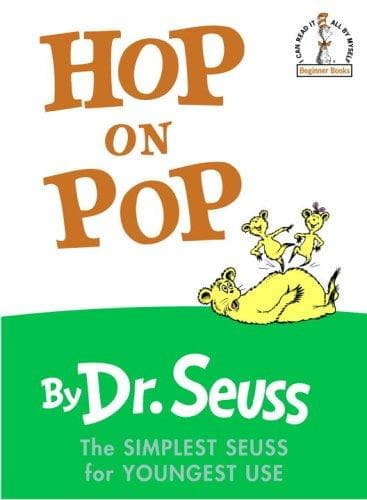
Hop on Pop
by Dr. Seuss
A tiny-vocabulary early reader that turns repetition and rhyme into a game, making it one of the most useful first books for children learning to read on their own.
What It's About
Hop on Pop is one of the Beginner Books Dr. Seuss produced in the early 1960s, written for children who are just starting to read by themselves. It is less a story than a set of short, bouncy lines built around a small stock of words, most of them one syllable, which the young reader sees again and again. Pages mostly contain brief rhymed phrases and playful nonsense, with the pictures doing much of the work of showing what each word means.
The experience is closer to a game than a narrative. A child reads a line, recognizes a word, sees it return on the next page, and gradually gains the confidence to read the whole book aloud. Adults reading to a child will notice the rhythm and silliness more than any plot, and the book works best as shared, back-and-forth reading rather than something to sit through quietly.
It is not meant for an adult looking for a literary experience, and it was never designed to be. Its value lies in how much it trusts small children to decode language with patience and humor. Readers who know Seuss from The Cat in the Hat or Green Eggs and Ham will recognize his rhythm, though this book is far more stripped down.
Read this if you…
- want a child to practice reading aloud with a confident, playful rhythm
- are helping a child recognize common words on sight
- enjoy Dr. Seuss's sound and silliness and want an early-reader version
Skip it if you…
- are looking for a story with plot, characters to care about, or emotional depth
- want a book that will challenge a reader beyond the earliest stage
Key Ideas
- 1
Repetition as a reading tool
The book reuses a small set of words so a child meets each one many times within a few pages. Repeated exposure helps early readers recognize words on sight instead of sounding out every letter, and that recognition is the main engine of the book's teaching.
- 2
Rhyme and rhythm to support decoding
Rhymed lines and a steady beat give children a predictable pattern. When a word is hard, the rhyme often hints at it, so a reader can guess and then check the guess against the letters. This builds the habit of using sound and context together.
- 3
Pictures that carry meaning
The illustrations show what the words describe, so a child who stumbles can use the picture as a clue. This makes the book feel partly like a visual puzzle, where understanding comes from matching text and image rather than from text alone.
- 4
Nonsense as an invitation to play
The silly situations and made-up pairings keep the reading light. The humor is what makes a child want to return to the book, and that willingness to come back matters as much as any skill the book teaches.
Limitations
The book has little plot and its characters are barely developed, so older children or adults hoping for a narrative may find it thin. Its vocabulary is deliberately narrow, which some teachers and parents find limiting once a child is past the first stages and needs more varied reading. Its picture of family life and its physical gags also reflect the early 1960s, so some parents may want to talk through them with a child.
Questions Readers Ask
- Is Hop on Pop good for children learning to read?
- Yes, it is among the best-known books for children at the very start of decoding. Its short lines, repeated words, and rhyming patterns give a new reader many quick wins, and the pictures help when a word is unfamiliar. It works best as a read-aloud book with an adult who can model the rhythm and encourage the child to try the words.
- How does it compare to Green Eggs and Ham?
- Green Eggs and Ham uses a slightly larger vocabulary and follows one continuous storyline, which gives it more momentum. Hop on Pop is more a sequence of short rhyming lines with little narrative thread. Many families use Hop on Pop earlier in a child's reading journey and move to Green Eggs and Ham once the child is more confident.
- Is Hop on Pop still relevant today?
- It remains widely used in classrooms and homes as a teaching tool because its controlled vocabulary still does what it was designed to do. Some of its humor and imagery feel dated, so adults may want to discuss those parts. As a first book for a beginning reader, it still holds up well.
- Published
- 1963
- ISBN
- 9789573214595
- Difficulty
- beginner
- Category
- Children's Books
Book details and cover from Google Books.
Ready to read Hop on Pop?
Get your copy on Amazon, or listen to it on Audible. We earn a commission if you buy through these links.