
We earn a commission if you buy through these links. Learn more
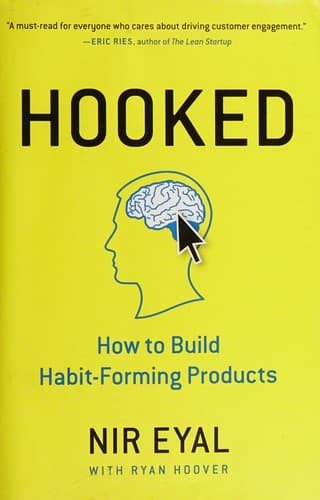
Hooked
by Nir Eyal
Guide by the Books of the Day editors · Updated · How we write our guides
A practical, short framework for understanding why some apps become hard to put down, written for people who build products and people who want to see the machinery.
What Creators Say About Hooked
2 creators reviewed Hooked on YouTube between 2020 and 2022, with 14.4K views between them. Their opinions are their own; we picked these reviews, we didn't write them.
What It's About
Hooked is a business book about how consumer products such as apps, websites, and games become part of people's daily routines. Eyal lays out a four-step loop he calls the Hook Model: a trigger, an action, a variable reward, and an investment that makes the next cycle more likely. He writes mainly for product builders, but the mechanics are easy to recognize for anyone who has lost an evening to a feed.
The style is practical and framework-driven. Each part of the loop gets an explanation of the psychology behind it, followed by examples from well-known products that show how teams apply it. Expect short chapters, simple diagrams, and a steady stream of business vocabulary. It reads quickly, and it is written with clear sympathy for founders who want people to actually use what they make.
The experience is part textbook, part provocation. The later chapters turn to ethics, asking when habit-forming design serves users and when it exploits them, and they offer questions a designer can ask themselves. Readers expecting a critical exposé will find something more optimistic than that, while readers who only want a playbook may find the ethics material adds weight they did not ask for.
Read this if you…
- are building or evaluating a consumer app or website and want a structured framework for thinking about engagement
- are curious how feeds, notifications, and games are engineered to pull people back
- want a short, practical read on habit formation that can be applied to product or marketing work
Skip it if you…
- want a rigorous academic treatment of habits, since the book relies on one model and selected case studies
- are looking for a critical account of the attention economy from an outside, skeptical viewpoint
Key Ideas
- 1
Triggers push people back toward a product
External triggers are cues such as notifications, emails, or app icons. Internal triggers are feelings the product becomes linked to, like boredom, loneliness, or uncertainty. Eyal argues that the strongest habits depend on internal triggers, which means a product has to become the familiar answer to a recurring discomfort.
- 2
Unpredictable rewards keep people returning
Rewards that vary are often more engaging than rewards that are always the same. Eyal draws on research about reinforcement and the pull of slot machines, and he sorts rewards into those of the tribe (social approval), the hunt (information or resources), and the self (mastery or completion).
- 3
Investment makes the next loop easier
When users add time, data, followers, or content, they store up value inside the product. That stored investment raises the odds of coming back and makes leaving more costly. Eyal also shows how investments can create new triggers, since people return to tend to what they have already built.
- 4
Lower the effort required to act
Eyal leans on behavior models that treat motivation, ability, and prompts as the ingredients of action. In practice, reducing friction often matters more than adding persuasion. A user who can act in one tap is far more likely to act than one who must first complete several steps.
- 5
Designers remain responsible for their choices
The book closes by asking whether a habit serves the user's own goals or only the company's metrics. Eyal suggests tests a builder can apply, such as asking whether users would endorse the habit if they understood it, and he treats vulnerable users as a special concern.
Limitations
Critics argue the Hook Model is a tidy framework built on hand-picked success stories, with thin evidence that the loop works across different products. Many examples date from the early 2010s, and the app landscape has shifted considerably since. The ethics sections are seen by some reviewers as too light given the author's stake in the industry. The book also treats habit formation mainly as a goal for companies rather than questioning whether every habit serves the people who form it.
Questions Readers Ask
- Is Hooked still relevant if its examples are from the early 2010s?
- Yes, for the framework. Several of the specific apps have changed or faded, but the trigger, action, reward, and investment loop still describes many current products. Reading it alongside newer critiques of attention-focused design gives a more balanced picture than the book alone.
- How does Hooked compare to Atomic Habits?
- James Clear's book is aimed at individuals who want to build better personal routines. Hooked is aimed at people designing products that shape other people's habits. If you want to change your own behavior, Clear is the better fit; if you build or study software, Eyal is more useful.
- Published
- 2014
- ISBN
- 9789089652706
- Difficulty
- beginner
- Category
- Consumer behavior
Book details and cover from Google Books.
Ready to read Hooked?
Get your copy on Amazon, or listen to it on Audible. We earn a commission if you buy through these links.