
We earn a commission if you buy through these links. Learn more
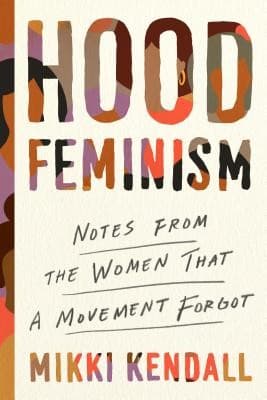
Hood Feminism
Mikki Kendall's sharp, practical case that feminism has long neglected poor women and women of color, and what a movement built around their needs would look like.
What It's About
Hood Feminism argues that the feminist movement, as it is usually told and marketed, centers the concerns of middle-class and white women and then presents that narrow agenda as universal. Kendall, who writes from a working-class Black background, takes up issues that tend to fall off the movement's list: food access, healthcare, policing, welfare, housing, school discipline, and the everyday economics of being poor and female.
The approach is conversational and essayistic rather than academic. Kendall moves between personal experience, reporting, and history, and she is blunt about who has been left out of well-known campaigns and why. The chapters are short and the arguments are often sharp. The tone can be angry, but the aim is practical: she is less interested in winning a theoretical debate than in asking what feminism would have to do differently if it actually helped the women it claims to speak for.
Reading it feels like being pulled into a conversation with a well-informed friend who has little patience for comfortable platitudes. It moves quickly and is easy to follow, though it works best if you come ready to be challenged rather than reassured. It also makes you notice where your own sense of the movement has been looking past certain people.
Read this if you…
- want a clear, direct critique of how mainstream feminism has treated poor women and women of color
- are interested in how economic and racial inequality shape everyday life for women
- are looking for a fast, accessible book that connects personal experience with wider social issues
Skip it if you…
- want a rigorous, citation-heavy history of feminist movements
- prefer your politics explained without anger or direct confrontation
Key Ideas
- 1
Feminism that ignores class and race
Kendall's central claim is that movement priorities have been set by the women with the most access to media and institutions. When campaigns center workplace advancement or public visibility, they can leave out women whose main pressures are money, safety, and survival. She treats this as a structural problem in how the movement organizes itself, not simply a matter of individual bad intentions.
- 2
Material needs as feminist issues
Kendall insists that hunger, unstable housing, medical neglect, and exposure to police violence are feminist questions. By framing these as core concerns rather than side issues, she widens what counts as a women's rights problem. The argument pushes readers to ask whether a movement can claim to fight for women while ignoring the conditions that shape their daily lives.
- 3
Who gets to tell women's stories
The book examines how a few voices and a few narratives come to represent the whole movement. Kendall looks at whose experiences get celebrated and whose get erased, and how that selection shapes what people believe feminism is for. It is a useful lens for thinking about any movement's public face and the gap between its image and its membership.
- 4
Solidarity has to be earned
Kendall rejects the idea that calling oneself a feminist automatically makes someone an ally. Real solidarity, in her account, means listening, sharing power, and taking on the costs of changing a movement's priorities. The book is less a call for better feelings than a challenge to show up in specific, sometimes uncomfortable ways.
Limitations
Hood Feminism is an argument and a survey rather than a comprehensive history, so many topics are touched on briefly and some readers will want more depth on any one of them. Some critics find the tone polemical and the framing of who speaks for whom too sweeping. Because it covers policy and social conditions, some specifics reflect the period it was written in and may have shifted since. Readers looking for detailed scholarship or a balanced survey of feminist thought should pair it with more academic sources.
Questions Readers Ask
- Who is Hood Feminism best for?
- It suits readers who already see gaps in how feminism is discussed and want those gaps named clearly. It is also a good fit for people new to intersectional thinking, since the writing is direct and grounded in concrete examples. Readers who are wary of anything that challenges their own views may find it uncomfortable, which is part of the point.
- How does it compare to bell hooks' Feminist Theory: From Margin to Center?
- hooks is more theoretical and historically structured, aiming to build a framework for feminism from the margins. Kendall is more direct and conversational, focusing on specific material conditions and current debates. If you want a foundational theory text, hooks is the stronger choice. If you want a sharp, accessible argument about present-day priorities, Kendall is often the easier entry point.
- Published
- 2020
- ISBN
- 9780525560548
- Difficulty
- beginner
- Category
- History
Book details and cover from Google Books.
Ready to read Hood Feminism?
Get your copy on Amazon, or listen to it on Audible. We earn a commission if you buy through these links.