
We earn a commission if you buy through these links. Learn more
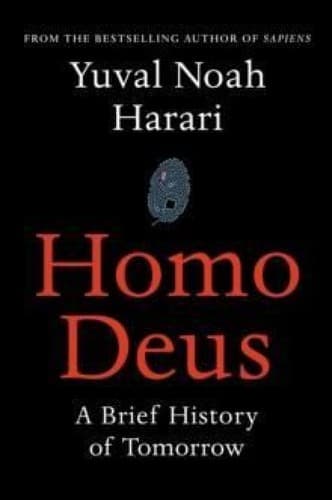
Homo Deus
A provocative forecast of humanity's next projects, after famine, plague and war are largely tamed, asking what happens to liberal ideals when algorithms may know us better than we do.
What It's About
Homo Deus is the follow-up to Sapiens, and it is written as a forecast rather than a history. Harari starts from a simple premise: humans have largely solved the old problems of famine, epidemic and large-scale war, so the question becomes what we will choose to pursue next. He sorts that agenda into a few broad ambitions, among them extending life, raising happiness, and upgrading human capacities, and he traces where current technology and economics could take them. The tone is confident and conversational, full of sweeping claims that are meant to be argued with.
The book moves between big historical framing and present-day debates about biotechnology, artificial intelligence, and data collection. Harari is less interested in gadgets than in the values underneath them. He treats humanism, the belief that individual experience is the final source of authority, as a story that has been dominant for a few centuries and may be losing its grip. Several chapters ask readers to notice how often they defer to outside systems for decisions about health, taste, and relationships.
Reading it feels less like studying a technical field than like being handed a set of provocations and a lot of questions. Some readers find the sweep exhilarating; others find it glib. The prose is clear, the examples are vivid, and the pages turn quickly, but the argument often runs ahead of the evidence, which is part of its appeal and part of its problem. You finish it wanting to test the claims rather than simply accept them.
Read this if you…
- are curious about where technology and society might be heading in the coming decades
- enjoyed Sapiens and want the bigger-picture follow-up
- like provocative ideas you can argue with rather than tidy conclusions
Skip it if you…
- want rigorous sourcing or detailed technical explanations of AI or biology
- prefer forecasts to be checked carefully against how events have actually unfolded
Key Ideas
- 1
Humanity's agenda after the old threats
Harari argues that once famine, disease and war are mostly under control, people will aim higher. He groups the likely goals into extending life, reaching sustained happiness, and gaining godlike abilities. The idea is less a prediction of any single outcome than a way of asking what we already reward and why.
- 2
Humanism as a story that can fade
The book describes humanism as the dominant modern belief that human experience and choice are the final source of meaning and authority. Harari suggests this view has shaped politics, markets and ethics for centuries, and that it could be displaced by other frameworks. Readers are invited to see their own assumptions about free will as part of that history.
- 3
Data flow as the new measure of value
Harari explores a worldview he calls dataism, in which the flow of information becomes the highest value and systems are judged by how well they process it. He traces how this idea gains ground in science, economics and everyday life. The chapter pushes readers to ask what gets lost when value is measured in data.
- 4
Algorithms that may know us better than we do
A central provocation is that computers analysing enough data could eventually make better decisions about our health, careers and relationships than we can ourselves. Harari uses this to question the authority of personal feeling and intuition. The argument is speculative, but it sharpens a real debate about trust in automated advice.
Limitations
Many of the book's predictions are speculative and some already look dated since its 2015 publication. Harari often blurs the line between description and prediction, and critics say his sweeping generalizations can outrun the evidence. Discussion of inequality, politics and climate is brief compared with the attention given to technology and philosophy. Specialists may find the treatment of AI and biotechnology accessible but shallow.
Questions Readers Ask
- Do I need to read Sapiens first?
- No. Homo Deus stands on its own, though it refers back to ideas from Sapiens and assumes some familiarity with Harari's big-history framing. Readers who start here will still follow the argument, but Sapiens provides useful context for the discussion of humanism and shared myths.
- Is Homo Deus still relevant after its 2015 publication?
- Parts of it have aged, especially specific predictions about AI, biotechnology and politics. The underlying questions about data, autonomy and the values behind technology remain current, so the book is most useful as a framework to test against recent developments rather than as a forecast to trust.
- Published
- 2017
- ISBN
- 9781784703936
- Difficulty
- intermediate
Book details and cover from Google Books.
Ready to read Homo Deus?
Get your copy on Amazon, or listen to it on Audible. We earn a commission if you buy through these links.