
We earn a commission if you buy through these links. Learn more
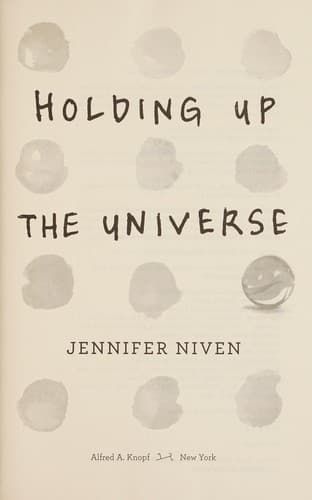
Holding Up the Universe
Guide by the Books of the Day editors · Updated · How we write our guides
A warm, unusually specific YA novel about face blindness, reputation, and grief, told through two teens who see each other more clearly than their schools do.
What Creators Say About Holding Up the Universe
2 creators reviewed Holding Up the Universe on YouTube between 2016 and 2018, with 7.5K views between them. Their opinions are their own; we picked these reviews, we didn't write them.
What It's About
Holding Up the Universe is a young adult novel built around Libby Strong, a teen who has prosopagnosia, or face blindness, which means she often cannot recognize people she knows, even those closest to her. After years of being mocked and misread, she is wary of the students at her new high school. Jack Masterson, a popular boy whose reputation has hardened into something he can't easily shake, becomes the other half of the story. Their alternating first-person chapters let the reader inhabit both perspectives.
Jennifer Niven writes in a direct, conversational voice that makes the book feel closer to a long talk with two friends than a lecture about a medical condition. The condition is explained through lived experience rather than clinical description, so you come to understand how Libby navigates a world built around faces. Grief and family strain run underneath the romance and the school drama, giving the book more weight than its breezy surface suggests.
Reading it is an easy, emotional experience. The chapters move quickly, the dialogue is lively, and the story is designed to pull you forward. It works best when you let it be sincere rather than reading it for literary ambition.
Read this if you…
- want a character-driven teen novel with a unique perspective on memory and recognition
- are interested in how a neurological difference feels from the inside
- enjoy dual-narrator stories that build slowly toward emotional payoffs
Skip it if you…
- need a realistic clinical account of prosopagnosia, since this is fiction first
- prefer dense, literary prose or challenging structures over a fast, accessible read
Key Ideas
- 1
Seeing people beyond their surface
The novel keeps returning to the gap between how people look and who they are. Libby cannot rely on faces, so she pays attention to voice, habit, and small behaviors. Jack is judged by a single version of himself that others have decided on. Both characters are forced to notice that first impressions are often wrong, and the book uses that idea as its central emotional argument.
- 2
Living with a hidden or invisible condition
Libby's face blindness is rarely visible to others, which makes it easy for people to assume she is rude or careless. The book shows how exhausting it is to manage a condition no one can see and how much energy goes into covering for it. It is one of the more thoughtful portrayals of a neurological difference in mainstream teen fiction.
- 3
Reputation and the cost of being labeled
Jack's standing at school depends on stories that have hardened around him, and he has little room to correct them. The novel examines how labels shape behavior, friendships, and self-image. It asks what it takes to step outside a role other people have written for you, and what you lose when you do.
- 4
Grief as the quiet undercurrent
Loss sits beneath the characters' lives and affects how they relate to others. The book handles grief with more restraint than many teen novels, letting it inform decisions and moods rather than serving only as a plot device. This gives the romance and school conflict a sense of stakes beyond popularity and crushes.
Limitations
Holding Up the Universe is a novel, so its portrayal of face blindness is shaped by the needs of the story and should not be treated as a medical guide. Some readers find the romance and dramatic beats predictable, and the high school setting leans on familiar archetypes. Critics sometimes note that the emotional moments are pushed hard. The book is written for teenagers, and adult readers looking for depth may find it lighter than they would like.
Questions Readers Ask
- Is Holding Up the Universe accurate about face blindness?
- It draws on the real experience of prosopagnosia and shows how it affects daily life, but it is a novel and simplifies for storytelling. It is a good way to understand the emotional texture of the condition. For clinical facts, a medical source or a book written by someone with the condition will be more reliable.
- Who is this book best suited for?
- It suits teenagers and adults who enjoy accessible, emotionally direct fiction. Readers curious about neurodiversity or invisible disabilities will find it thoughtful. If you want a dense or highly experimental novel, you will likely find it too straightforward.
- Published
- 2016
- ISBN
- 9783733503697
- Difficulty
- beginner
- Category
- Psychology
Book details and cover from Google Books.
Ready to read Holding Up the Universe?
Get your copy on Amazon, or listen to it on Audible. We earn a commission if you buy through these links.