
We earn a commission if you buy through these links. Learn more
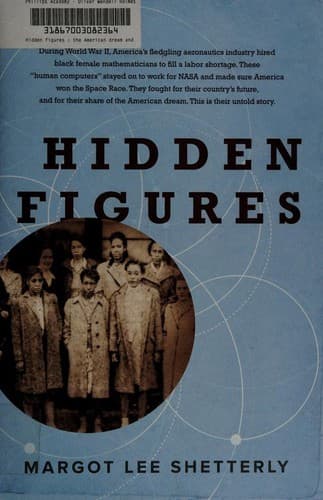
Hidden Figures
A clear, humane account of the Black women mathematicians whose calculations helped launch American spaceflight, told with more historical breadth than the film.
What It's About
Hidden Figures follows a group of Black women who worked as human computers at the National Advisory Committee for Aeronautics' Langley research center in Hampton, Virginia, from the 1930s into the 1960s. Their job was to turn aerodynamic and flight data into usable numbers, first with pencils and mechanical calculators, later alongside early electronic machines. The book centers on Dorothy Vaughan, Mary Jackson, and Katherine Johnson, while bringing in many other women whose work is less familiar.
Margot Lee Shetterly grew up in Hampton, and her father was a scientist at the same lab, which gives the book a sense of place. Her approach blends archival research with interviews and institutional history. It reads more like a social history of a workplace than a single-life biography, moving between individual careers, the segregated computing unit they worked in, and the larger push of the space race. The pace is steady, and it spends more time explaining the work than many readers will expect, though the technical material stays accessible.
Reading it feels like watching institutions quietly use talent while limiting who is allowed to advance. The tone is warm and admiring without becoming melodramatic. It suits readers who want the context a two-hour film has to compress.
Read this if you…
- Want the fuller history behind the 2016 film and its characters
- Are interested in the early space program told through the people doing the work
- Enjoy social history of workplaces and how institutions treat their staff
Skip it if you…
- Want a deep technical explanation of orbital mechanics or aerodynamics
- Prefer a tightly plotted narrative built around one protagonist's arc
Key Ideas
- 1
Computing was skilled work done by hand
Before electronic computers were common, the calculations behind flight research were done by people with paper, pencils, and desk machines. The book shows how demanding this labor was and how much judgment it required, which challenges the idea that the math was a backdrop to the real engineering.
- 2
Segregation shaped careers inside a federal lab
Black women were assigned to a separate computing unit and faced limits on promotion, office space, and access to training. The book examines how these rules were applied day to day, and how workers navigated them without treating the institution's barriers as the whole story of their lives.
- 3
Advancement through persistence and narrow openings
Progress came in small steps, such as taking on supervisory duties, learning programming languages, or moving into engineering roles when openings appeared. Shetterly presents these moves as strategic and hard-won, showing how each woman created new paths that others could follow.
- 4
Scientific progress as a collective effort
The space program is often told through a few famous names. This book argues that large projects depend on many people doing unglamorous work, and that leaving them out distorts how we understand how discoveries actually happen.
Limitations
Some critics note that the book relies partly on interviews and family recollections, so certain scenes and dialogue are reconstructed rather than documented. Its focus stays closely on the Langley workplace, so it says less about life in Hampton, the wider Black community, or the civil rights movement beyond the lab. The organizational detail can feel dense in places, and readers hoping for more personal reflection from the women themselves may find the portraits drawn more from outside perspectives than their own words.
Questions Readers Ask
- Is Hidden Figures the book the movie is based on?
- Yes. The 2016 film was adapted from this nonfiction book. The movie condenses events and combines some characters for dramatic reasons, while the book covers a longer period, more people, and the broader history of the Langley computing unit. Readers who liked the film often find the book adds considerable depth.
- Is the book still relevant today?
- Yes. It remains a useful introduction to how women and Black Americans contributed to aerospace work that is often told without them. Its themes of who gets credit and who gets hired into technical fields still resonate, though readers may want newer scholarship for current data on the STEM workforce.
- Published
- 2016
- ISBN
- 9781432843274
- Difficulty
- beginner
- Category
- Biographies
Book details and cover from Google Books.
Ready to read Hidden Figures?
Get your copy on Amazon, or listen to it on Audible. We earn a commission if you buy through these links.