
We earn a commission if you buy through these links. Learn more
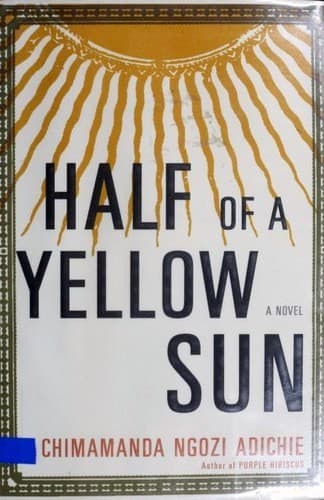
Half of a Yellow Sun
Guide by the Books of the Day editors · Updated · How we write our guides
A sweeping, intimate novel of love, class, and loyalty set against the Nigerian Civil War, showing how ordinary lives bend and break under the weight of history.
What Creators Say About Half of a Yellow Sun
2 creators reviewed Half of a Yellow Sun on YouTube between 2020 and 2023, with 197.6K views between them. Their opinions are their own; we picked these reviews, we didn't write them.
What It's About
Half of a Yellow Sun follows a small circle of people in Nigeria in the 1960s. At its center are Odenigbo, a university lecturer with strong political convictions; Olanna, the partner who leaves a privileged Lagos life to live with him; her twin sister Kainene; and Ugwu, a young villager who arrives to work in their household. The story moves through the years before and during the Biafran War, when the mostly Igbo eastern region tried to secede and the country fell into famine and bloodshed.
Adichie alternates between the characters' perspectives and between time periods, so the same events are seen through very different eyes: an academic who believes in argument, a woman navigating love and a changing social world, a boy learning what politics costs, and a British writer trying to understand a country that is not his. The prose is warm, observant, and often funny in its dialogue, which makes the later suffering land harder.
Reading it feels less like following a plot than living alongside a household as its certainties erode. The war arrives through rationing, rumour, displacement, and small compromises rather than a tidy historical lesson. The book is long and emotionally heavy, and it asks you to sit with grief rather than hurry past it.
Read this if you…
- want a novel that uses personal relationships to explain a major historical event
- enjoy multi-perspective storytelling that gradually builds emotional weight
- are interested in postcolonial Africa and how independence shaped everyday life
Skip it if you…
- need fast-paced plot momentum or a light read
- prefer novels that stay at a clear emotional distance from their violence
Key Ideas
- 1
Politics as something lived at home
The novel treats politics less as speeches and more as something that enters kitchens, classrooms, and friendships. Arguments about nationhood, tribe, and fairness play out over dinner tables and in offices, and the characters discover that their private choices are shaped by public decisions they never voted on. Adichie makes the abstract feel personal, which is why the historical material stays so vivid.
- 2
Love tested by class and loyalty
Relationships in the book are constantly pressured by money, family expectations, ethnic identity, and divided loyalties. Couples and siblings are shown trying to stay faithful to each other while the world pulls them apart. The novel is less interested in romance as an escape than in what affection demands when it must survive humiliation, scarcity, and betrayal.
- 3
Who gets to tell the story
One of the novel's quieter concerns is authorship: who records events, whose version counts, and how outsiders and insiders understand the same catastrophe differently. The book places characters with unequal access to power and to words, and it lets the reader notice the gap between what each of them believes is happening.
- 4
Ordinary moral compromise under siege
Rather than sorting its characters into heroes and villains, the novel shows people making small, understandable compromises that add up to serious consequences. Hunger, fear, and pride push them toward choices they later struggle to justify. The moral texture is complicated, and that complexity is much of the book's power.
Limitations
Some readers find the shifting timelines and large cast hard to track early on, and the first sections can feel slow before the war begins. The war scenes are harrowing, and a few critics have felt the suffering is sometimes laid on heavily. As a novel, it offers one writer's shaped view of Biafra rather than a complete history, and debates about the conflict's causes and the portrayal of the different groups involved have continued. It is best read as fiction that illuminates a history, not as a substitute for studying it.
Questions Readers Ask
- Is Half of a Yellow Sun based on real events?
- Yes. The novel is set during the Nigerian Civil War of 1967 to 1970, when the eastern region attempted to secede as Biafra, and it depicts the famine and fighting that followed. The characters are invented, but the historical backdrop is real, and Adichie's account of the period is central to why the book is so widely read and taught.
- Do I need to know Nigerian history before reading it?
- No. The novel gives enough context through its characters and their arguments to follow the events. Some background on the Biafran War will deepen your reading, but it is not required. Many readers look up the history afterwards, which can make the book feel even more affecting.
- How does it compare to Things Fall Apart?
- Chinua Achebe's Things Fall Apart focuses on pre-colonial Igbo life and the arrival of colonial rule, while Half of a Yellow Sun covers a later period of independence and civil war. Readers who appreciated Achebe's clarity may find Adichie's more intimate, multi-voiced approach a different but rewarding companion piece.
- Published
- 2006
- ISBN
- 9780007272372
- Difficulty
- intermediate
- Category
- Fiction
Book details and cover from Google Books.
Ready to read Half of a Yellow Sun?
Get your copy on Amazon, or listen to it on Audible. We earn a commission if you buy through these links.