
We earn a commission if you buy through these links. Learn more
Gravity's Rainbow
Guide by the Books of the Day editors · Updated · How we write our guides
A sprawling, funny, paranoid novel about WWII, rockets, and control systems that rewards patient readers with one of the most ambitious American books of the twentieth century.
What Creators Say About Gravity's Rainbow
2 creators reviewed Gravity's Rainbow on YouTube between 2020 and 2025, with 105K views between them. Their opinions are their own; we picked these reviews, we didn't write them.
What It's About
Gravity's Rainbow is a huge novel set mostly in Europe in the last year of the Second World War. It follows a cluster of characters, most centrally Tyrone Slothrop, an American intelligence officer whose body seems to have been mapped to the locations of German rocket strikes in London. The plot keeps breaking open into side stories, but the central pull is a question of who is actually running the war, and whether anyone understands what they are building.
Pynchon writes in a restless, digressive style that moves between slapstick, songs, parody, technical lectures, and dense lyrical passages without warning. The narrative voice shifts often and rarely explains itself, so reading the book feels less like following a story and more like working out a map while the ground moves. There are long stretches where you may not know what is happening, and that disorientation is deliberate.
The experience is demanding but rarely dull. Many readers describe a rhythm of confusion followed by sudden clarity, then a return to confusion. The jokes are dense and the references wide, so a willingness to look things up or simply to keep going matters more than any single detail.
Read this if you…
- want a long, ambitious novel that rewards close attention and rereading
- enjoy comic, digressive writing that mixes high culture with pulp and slapstick
- are interested in how technology, war, and corporate power connect
Skip it if you…
- need a clear plot and steady forward momentum from page to page
- find explicit sexual content, scatological humor, or graphic violence hard to get through
Key Ideas
- 1
Paranoia as a way of seeing the world
Slothrop's sense that he is being watched, traded, and used by unseen organizations is the book's engine. Pynchon treats paranoia not only as a symptom but as a reasonable response to a world where corporations, militaries, and states are tangled together. The question the novel keeps asking is whether the pattern the characters see is real or whether seeing patterns is itself the trap.
- 2
The rocket as an image of modern power
The V-2 rocket, with its arc from launch to impact, becomes the book's central symbol. It stands for a technology that arrives without warning, that kills from the sky, and that points toward a future governed by machines and the people who control them. Pynchon returns to the rocket's trajectory again and again, using it as a way to think about inevitability and destruction.
- 3
Behavioral control and the engineering of desire
Pavlovian conditioning and other techniques of behavioral psychology run through the novel as a model for how people are shaped by reward, fear, and sex. Pynchon links these methods to wartime institutions and to ordinary life, asking how much of what we want has been arranged for us. The theme is unsettling because it refuses to separate the personal from the political.
- 4
A style built on excess and misdirection
The prose is encyclopedic, funny, and often deliberately overwhelming. Pynchon mixes genres, switches perspectives, and interrupts scenes with songs and digressions, which mirrors the fragmented information the characters receive. The reader is forced into an active role, assembling meaning from scraps instead of being guided toward a single reading.
- 5
Buried histories and colonial violence
Alongside the wartime plot, the novel reaches back to German colonial atrocities and to the people whose suffering the official narratives leave out. These threads widen the book beyond a war story into a meditation on how history is recorded, forgotten, and reshaped by those in power.
Limitations
The book is long and dense, and many readers find its middle sections hard to follow without outside help. Its sprawling cast and frequent shifts in perspective can feel like a test of stamina rather than a pleasure. Some of its pop-culture jokes and references now feel dated, and its treatment of women and sexuality has been criticized as crude or stereotyped. Readers who want a tidy resolution or a closed argument will likely be frustrated, since the novel deliberately leaves much unexplained.
Questions Readers Ask
- Is Gravity's Rainbow worth reading for a general reader?
- Yes, if you are willing to be confused for long stretches and to read at a slower pace than usual. Many readers find the comedy and the set pieces rewarding even when the larger design is hard to see. Reading a companion guide alongside it can help, but it is not required to enjoy the book on its own terms.
- How does it compare to The Crying of Lot 49?
- Lot 49 is much shorter and more focused, following a single woman through a mystery about a hidden postal system. Gravity's Rainbow uses similar interests in paranoia and hidden networks but expands them into a vast, multi-character novel. Lot 49 is a good first Pynchon if this one feels like too much.
- Published
- 1973
- ISBN
- 9780140996999
- Difficulty
- advanced
- Category
- Fiction
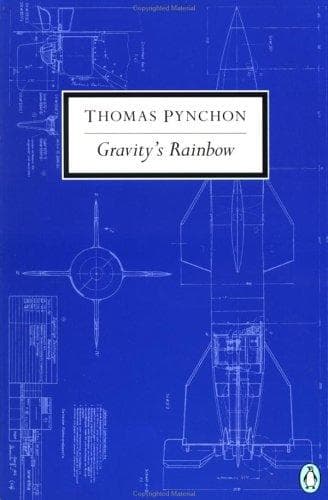
Book details and cover from Google Books.
Ready to read Gravity's Rainbow?
Get your copy on Amazon, or listen to it on Audible. We earn a commission if you buy through these links.