
We earn a commission if you buy through these links. Learn more
Grandfather's journey
by Allen Say
A short, quiet picture book that uses one family's story to capture the pull of two homelands, and it hits harder than its length suggests.
What It's About
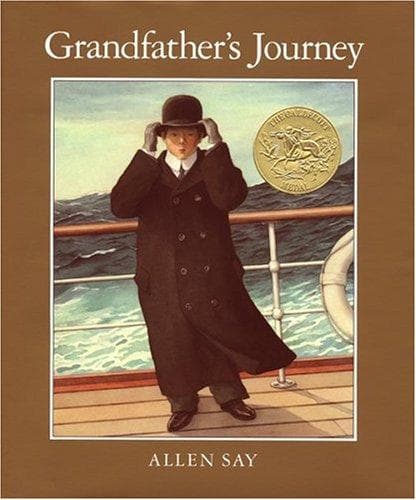
Grandfather's Journey is a short picture book, though it is easy to underrate. Allen Say draws on his own family history to tell the story of his grandfather, a young Japanese man who leaves home, travels to America, and falls hard for the landscapes of California. The narrative moves through his life in a loose, reflective way, and its emotional center is a restless man who never fully settles in either country.
Say's paintings do much of the work. The scenes are carefully composed, with a restrained palette and an attention to light and empty space, so many pages feel like remembered photographs. The text sits quietly beside the images in a plain, first-person voice that reads more like an elder recalling a life than a plot-driven story. Small domestic details and changes of landscape carry as much meaning as the sentences do.
Reading it takes only a short sitting, but it rewards a slower pace. Expect a book that trusts lingering images and understatement rather than action or suspense. It is less about adventure than about the quiet ache of belonging to two places at once, and many readers find that it stays with them well after they close it.
Read this if you…
- Want a short, thoughtful book about immigration, identity, or family memory
- Enjoy picture books that reward adult readers as much as children
- Are interested in the Japanese-American experience told through a personal, intimate story
Skip it if you…
- Need a plot with conflict, momentum, or a clear sense of resolution
- Want a detailed historical account of Japanese emigration and its context
Key Ideas
- 1
Homesickness for two countries at once
The book's central feeling is not simple longing for home but a divided sense of belonging. The grandfather loves the place he left and the place he chose, and neither fully satisfies him. Say presents this without easy resolution, which is why the book resonates with readers who have lived between cultures or who have a relative who did.
- 2
Restlessness as an inherited trait
Wandering is portrayed less as adventure than as a temperament that shapes a life. The story suggests that some people carry an unsettled spirit that makes contentment hard to hold on to. Seen through a grandchild's eyes, that restlessness becomes a family inheritance that the narrator understands and perhaps shares.
- 3
Memory passed from one generation to the next
The book is framed as a grandchild's memory of a grandparent's life, which makes it an act of family history. Say treats the telling itself as important, showing how stories about ancestors are handed down and reshaped. The reader is asked to consider what gets remembered and what is left out.
- 4
Pictures that carry the emotional weight
Much of the meaning lives in the illustrations rather than the text. Changes in color, scale, and composition signal shifts in mood, time, and place. Readers who pay attention to the images will get more out of the book than those who race through the words.
Limitations
The book is very brief, so it gives only a sketch of its characters and their inner lives. The grandfather's perspective is filtered through a grandchild's memory, which some readers find keeps him at a distance. Historical and social context is light, and readers looking for an account of the period will need other sources. The melancholy tone and understated emotions may feel unsatisfying to those who want a more explicit emotional payoff.
Questions Readers Ask
- Is Grandfather's Journey only for children?
- No. It is written as a picture book and is accessible to young readers, but its themes of belonging, memory, and divided loyalty speak strongly to adults. Many readers come back to it later in life and find new things in the paintings and the restrained text. It works well as a shared read across ages.
- Is it based on a true story?
- The book draws on Allen Say's own family history and his grandfather's life. Say presents it as a personal story rather than a documented biography, so it is best read as a reflective family account. It is a good starting point for thinking about how real lives get shaped into narrative.
- Published
- 1993
- ISBN
- 9780547076805
- Difficulty
- beginner
- Category
- Fiction
Book details and cover from Google Books.
Ready to read Grandfather's journey?
Get your copy on Amazon, or listen to it on Audible. We earn a commission if you buy through these links.