
We earn a commission if you buy through these links. Learn more
Goodnight Moon
Guide by the Books of the Day editors · Updated · How we write our guides
A 1947 bedtime picture book whose quiet, repetitive ritual still works on toddlers and rewards adults who read it aloud slowly.
What Creators Say About Goodnight Moon
2 creators reviewed Goodnight Moon on YouTube between 2016 and 2022, with 9.7M views between them. Their opinions are their own; we picked these reviews, we didn't write them.
What It's About
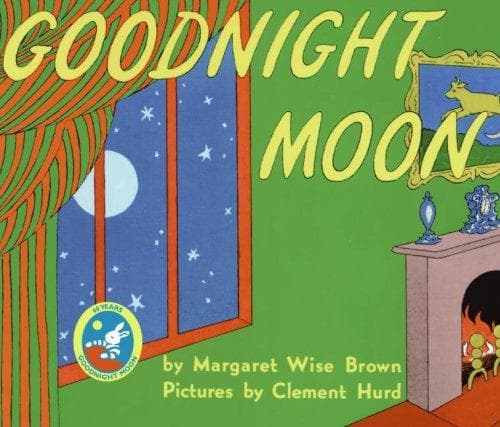
Goodnight Moon is a picture book first published in 1947, written by Margaret Wise Brown and illustrated by Clement Hurd. It follows a young rabbit getting ready for sleep in a room full of ordinary things: lamps, a telephone, a bowl, pictures on the wall, and a few toys. The structure is a bedtime ritual, a slow sequence of farewells that moves from object to object while the light in the room gradually fades.
The experience is mostly about rhythm and looking. The text is short, repetitive, and built for reading aloud, with a steady cadence and soft sounds that many adults find soothing to perform. Hurd's pictures carry much of the story. The room shifts from bright to dim across the pages, and small details reward a second or third look. Little happens in a conventional sense, and there is no conflict to resolve.
For a toddler, the book works as a practice in winding down and a gentle introduction to the idea of saying goodbye to the day. For an adult, it reads as a deliberately spare piece of design, and the appeal lies in its pacing rather than its plot. It takes only a few minutes to read, and most families end up reading it many times.
Read this if you…
- want a bedtime book that works best when read slowly and repeatedly
- are looking for a classic that shaped American picture books for decades
- enjoy spare, rhythmic language and quiet illustrations that reward close looking
Skip it if you…
- want a story with a clear plot, conflict, or character growth
- need a book that holds an older child's interest beyond the first few readings
Key Ideas
- 1
Bedtime ritual as the entire structure
The book has no plot in the usual sense. Its shape is the routine many families follow each night, arranged as a sequence of small farewells. That makes it predictable, which is much of its appeal for very young children who find comfort in knowing what comes next.
- 2
Naming the world before letting it go
Each farewell names a specific thing in the room, so the book works as a quiet inventory of a child's surroundings. Saying goodnight to familiar objects becomes a way of acknowledging the day and settling into it, rather than just switching off.
- 3
Rhythm and sound built for reading aloud
The language is simple, repetitive, and musical. Its value comes largely from how it sounds in an adult's voice, with the rhythm slowing the reader down. Many people remember it as a sound before they remember it as a story.
- 4
Pictures that carry a slow change
Hurd's illustrations do the narrative work the text leaves out. The gradual dimming of the room and the changing light across the spreads give the book its sense of time passing, so attentive readers notice more on each reading.
Limitations
Some readers find the book too repetitive, especially adults who read it dozens of times. Its story is intentionally minimal, so it offers no conflict, humor, or arc for older children. The domestic setting, with its particular furnishings and mid-century household details, can feel dated to some families, and the sleepy, hushed tone is not for every child, particularly one who resists bedtime. It is a bedtime book in scope and does not try to address other subjects.
Questions Readers Ask
- Is Goodnight Moon still worth reading to a child today?
- Yes, for many families it remains a reliable choice for toddlers and preschoolers. Its short length and repetitive rhythm make it easy to follow, and its bedtime routine matches what many households still do. Some parents find the setting dated, but the core experience of the book has held up well.
- Who is Goodnight Moon best suited for?
- It suits babies, toddlers, and preschoolers, and the adults reading to them. It works best for children who are ready for a calm wind-down before sleep. Older children who want plot or humor will probably lose interest quickly, though they may still enjoy looking at the pictures.
- How does it compare with other bedtime picture books?
- Compared with more playful bedtime books that rely on jokes or adventures, Goodnight Moon is quieter and more meditative. It asks the reader to slow down rather than to be entertained. Families who want a livelier read-aloud may prefer something with more action and dialogue.
- Published
- 1947
- ISBN
- 9780060275044
- Difficulty
- beginner
- Category
- Children's Books
Book details and cover from Google Books.
Ready to read Goodnight Moon?
Get your copy on Amazon, or listen to it on Audible. We earn a commission if you buy through these links.