
We earn a commission if you buy through these links. Learn more
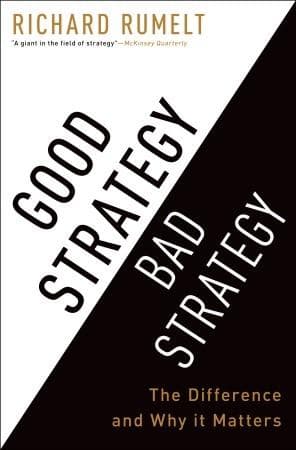
Good Strategy, Bad Strategy
Guide by the Books of the Day editors · Updated · How we write our guides
Rumelt gives you a practical test for telling a real strategy from the empty plans, slogans, and wish lists that most organizations produce, and it is short enough to read in a few sittings.
What Creators Say About Good Strategy, Bad Strategy
2 creators reviewed Good Strategy, Bad Strategy on YouTube between 2022 and 2023, with 28.7K views between them. Their opinions are their own; we picked these reviews, we didn't write them.
What It's About
Good Strategy, Bad Strategy is Richard Rumelt's argument that most of what companies, governments, and nonprofits call strategy is really goals, slogans, or budget documents dressed up in strategic language. Rumelt, a longtime strategy professor, spends the book building a working definition of what a real strategy looks like and then showing where organizations go wrong.
The approach is more analytical than inspirational. Rumelt moves between business cases, military history, and public policy, and he keeps returning to a short core he calls the kernel: a diagnosis of the challenge, a guiding policy for dealing with it, and coherent actions that carry the policy out. The chapters are argumentative rather than checklist-driven, so reading it feels closer to listening to a sharp advisor who has seen too many bad plans than to following a method.
The experience is brisk and a little combative. Much of the pleasure comes from Rumelt's willingness to name specific symptoms of bad strategy and his impatience with buzzwords. You finish with a vocabulary for judging plans, including the question of whether a document actually makes a choice, rather than a detailed playbook you can apply line by line.
Read this if you…
- want a practical filter for judging the strategy documents your organization produces
- work in management, leadership, or policy and have sat through too many vision statements
- prefer clear argument and plain language over frameworks and jargon
Skip it if you…
- want a step-by-step toolkit with templates, worksheets, and implementation checklists
- are looking for a narrative business book full of inspiring founder stories
Key Ideas
- 1
The kernel of a real strategy
Rumelt's core structure has three parts. A diagnosis names the crux of the challenge, a guiding policy sets an overall approach that narrows the field of options, and coherent actions are the steps that put that approach into practice. The value lies in the three fitting together, and a plan missing any one of them is usually not a strategy at all.
- 2
Hallmarks of bad strategy
Rumelt identifies recurring warning signs: fluff, where inflated language hides a lack of thought; failure to face the real challenge; mistaking goals for strategy; and bad strategic objectives that are vague or unattainable. He treats these as tests you can run on a document in an afternoon, which makes the ideas immediately usable.
- 3
Concentrating strength where it counts
Good strategy looks for places where focused effort or a small advantage can produce an outsized result, rather than spreading resources evenly across everything. Rumelt frames this as leverage, the idea that the right move at the right point can matter far more than broad, equal investment across the whole organization.
- 4
Why diagnosis matters more than vision
Many plans skip past the hard work of identifying the obstacle and jump straight to aspirations. Rumelt argues that an honest, clear reading of the situation is what makes later choices meaningful. Without it, even an inspiring vision has nothing to push against and rarely changes what people actually do.
Limitations
Critics point out that the sharpest examples lean on a handful of well-known corporate and military cases, and that the ideas are easier to apply to spotting bad plans than to building good ones from scratch. Some readers find the argument repetitive, as Rumelt returns to the same points from several angles. The book offers little on implementation, team dynamics, or running a strategy process inside a large bureaucracy, and its framing reflects the competitive planning world of its time, so readers in fast-changing sectors may need to adapt it.
Questions Readers Ask
- Who is Good Strategy, Bad Strategy best suited for?
- It suits managers, founders, consultants, and anyone who writes, reviews, or approves plans. You don't need a business degree, but it rewards readers who already deal with organizational decisions, because the tests it offers are most useful when you can apply them to a real document you are working on.
- Is the book still relevant?
- Largely, yes. The core ideas about diagnosis, choice, and focus don't depend on a particular technology or trend, so they hold up well. Some examples feel dated, but the warning signs of empty strategy apply across eras and sectors, which is why the book keeps being recommended.
- How does it compare to Michael Porter's work?
- Porter offers analytical tools such as the five forces framework for studying an industry. Rumelt is less interested in tools for analysis and more interested in whether a strategy holds together logically. Many readers find the two complementary, using Porter to understand the landscape and Rumelt to judge the plan built on it.
- Published
- 2011
- ISBN
- 9781846684807
- Difficulty
- intermediate
- Category
- Business
Book details and cover from Google Books.
Ready to read Good Strategy, Bad Strategy?
Get your copy on Amazon, or listen to it on Audible. We earn a commission if you buy through these links.