
We earn a commission if you buy through these links. Learn more
God's war
A sweeping, readable history of the Crusades that treats holy war as a religious, political and military project, not a simple clash of civilisations.
What It's About
Despite the fiction category listed for this page, God's War is a nonfiction history of the Crusades. Christopher Tyerman, an Oxford historian of the medieval period, covers the movement across its long span, beginning with the call to arms at Clermont in 1095. He follows the campaigns to Jerusalem and the Levant, but also the expeditions in Iberia, the Baltic, and against heretics in southern France, arguing that all of these belong to the same phenomenon.
The approach is narrative-driven but analytical. Tyerman pays close attention to how contemporaries understood the crusade, as pilgrimage, penance and a route to salvation, and to how papal authority, money and local rivalries shaped what actually happened. Rather than telling one tidy story of Christians against Muslims, he keeps the quarrels among crusader states and the varied responses of Muslim powers and the Byzantines in view.
Reading it feels like being guided through a large, crowded territory by someone who knows where the arguments are. It asks for patience with names, dates and shifting alliances, and it rewards readers who want the big picture grounded in detail. It is less a collection of battle stories than an extended attempt to explain why the movement lasted so long.
Read this if you…
- want a single-volume, scholarly overview of the crusading movement across its full span
- are curious why crusading lasted for centuries rather than wanting a list of battles
- enjoy history that tracks ideas, religion and politics alongside military events
Skip it if you…
- want a vivid, character-driven narrative of individual knights or commanders
- need a short introduction, since the book's length and detail take real commitment
Key Ideas
- 1
Crusading as a religious undertaking
Tyerman takes the spiritual dimension seriously. Taking the cross meant making a vow, and participants understood their service as penance with real rewards for the soul. Understanding these beliefs is essential to seeing why people risked property, family and life, and why the movement could draw such large numbers over generations.
- 2
Crusades beyond the Holy Land
One of the book's central arguments is that the term covers far more than the expeditions to Jerusalem. Campaigns in Iberia, the Baltic and against fellow Christians labelled heretics were also framed as crusades. Seeing these together shows how flexible the idea was and how the papacy could extend it to new enemies and new frontiers.
- 3
Politics and piety at the same time
Tyerman does not treat devotion and self-interest as opposites. Kings, nobles, merchant cities and popes pursued land, trade, prestige and power while speaking the language of God's cause. The book keeps both motives in view, which makes the failures and rivalries of the crusader states easier to understand.
- 4
The wider Mediterranean context
The crusades are placed among the Byzantine Empire, the various Islamic powers and the Latin settlers who stayed in the East. This wider frame shifts attention away from purely Western accounts and shows that the outcomes depended as much on regional politics and shifting alliances as on the arrival of armies from Europe.
Limitations
Its breadth means some regions and episodes get less depth than specialists would like, and the sheer volume of material can make the middle sections feel dense. Because the surviving sources are largely Latin and Christian, the Muslim perspective is present but less central than some readers may want. The book was published in 2006, and newer scholarship on Byzantine and Islamic viewpoints and on the crusade idea has since appeared, so it is worth pairing with recent work.
Questions Readers Ask
- Is God's War a novel?
- No. Although this page lists it under fiction, God's War is a nonfiction history of the Crusades by Christopher Tyerman, published in 2006. If you want a story about medieval knights, historical fiction would suit you better, but this book is a serious work of scholarship written for general readers.
- How does it compare with other histories of the Crusades?
- Readers often compare it with Steven Runciman's classic three-volume history. Runciman offers a sweeping narrative of the period, while Tyerman is more shaped by questions about motive, belief and the wider meaning of crusading, and he takes a broader view of which campaigns counted as crusades.
- Published
- 2006
- ISBN
- 9780674030701
- Difficulty
- intermediate
- Category
- Fiction
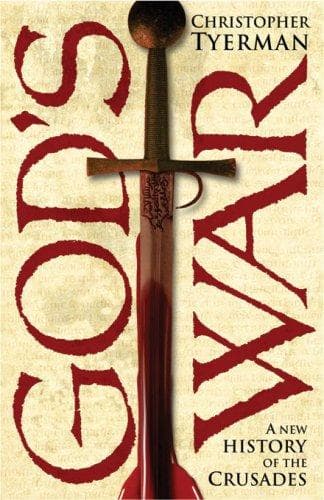
Book details and cover from Google Books.
Ready to read God's war?
Get your copy on Amazon, or listen to it on Audible. We earn a commission if you buy through these links.