
We earn a commission if you buy through these links. Learn more
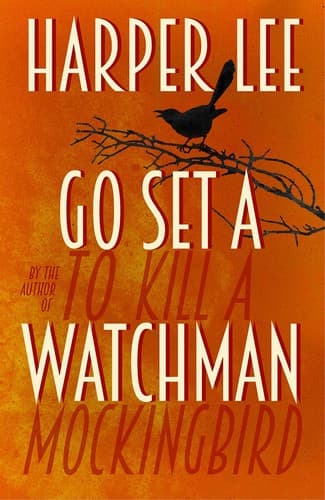
Go Set A Watchman
by Harper Lee
Guide by the Books of the Day editors · Updated · How we write our guides
Harper Lee's first draft of the Maycomb story, in which an adult Scout returns home and finds her father's politics harder to forgive than her childhood ever let her see.
What Creators Say About Go Set A Watchman
2 creators reviewed Go Set A Watchman on YouTube in 2015, with 22.9K views between them. Their opinions are their own; we picked these reviews, we didn't write them.
What It's About
Go Set a Watchman, published in 2015, is an adult novel even though many shelves file it under children's books. It follows Jean Louise Finch, called Scout, now in her mid-twenties and living in New York, as she travels back to Maycomb, Alabama, to see her father, Atticus, and the people who raised her. The story moves between the present-day visit and memories of her girlhood, so the reader watches a familiar world look different through older eyes.
Lee's style here is more conversational and more openly argumentative than the book most people know. Much of the energy comes from Scout's arguments with the men and women around her about race, loyalty, and what it means to belong to a place you have begun to doubt. Long stretches are dialogue-driven, and the tone can swing from wry comedy to hard, confrontational scenes. It reads like a draft still being shaped, with rough transitions and uneven pacing that some readers will find frustrating.
Reading it is less like returning to a comfortable classic and more like sitting through a family argument you were not supposed to overhear. It asks you to hold affection and disappointment in the same hand, and it refuses to let either one win cleanly.
Read this if you…
- are curious how a famous novel was first conceived and want to see its characters from a different angle
- can tolerate an argumentative book with uneven pacing and unresolved tensions
- want to think hard about how childhood heroes hold up under adult scrutiny
Skip it if you…
- want the warm, tightly structured storytelling of To Kill a Mockingbird
- find political argument in fiction tiring or prefer books with a clear moral lesson
Key Ideas
- 1
Loving a place while rejecting its values
Scout is genuinely attached to Maycomb, yet she discovers that people she loves hold views she finds repugnant. The book treats home as both real and complicit, and it asks what loyalty owes to a community that is changing around you.
- 2
The idealized father tested by reality
Atticus is the moral hero of To Kill a Mockingbird, and this book deliberately complicates that image. He appears as a man of his time and place, with convictions that clash with his daughter's. Readers have to weigh their memory of a hero against the man on the page.
- 3
Childhood memories seen by an adult
The flashbacks reframe events Scout once understood simply. Part of the book's quiet work is showing how growing up changes not only what you know but how you interpret the people who shaped you, including the moments you thought you understood completely.
- 4
Desegregation debates in 1950s Alabama
The novel engages with the politics of the post-1954 Supreme Court ruling on school desegregation and with the white citizens' councils that opposed it. It does this mostly through conversation and confrontation rather than courtroom drama, which makes the arguments feel personal.
- 5
How publication history shapes reading
Knowing that this manuscript came before To Kill a Mockingbird, and that its 2015 release raised questions about editing and consent, changes how you read it. Many readers approach it as an earlier, rougher work rather than a polished sequel, and that framing helps.
Limitations
The most common criticism is that this reads as an unfinished draft. The structure shifts abruptly between present and past, several conversations run long, and some characters feel flattened into mouthpieces for opinions. Critics have also argued that Atticus's transformation is not fully convincing, and that the book's handling of race is shaped by the era it was written in. Questions about how the manuscript came to be published remain part of the reading experience for many people, and they are worth knowing about before you start.
Questions Readers Ask
- Is Go Set a Watchman a sequel to To Kill a Mockingbird?
- Not really. Lee wrote this manuscript before To Kill a Mockingbird, and the 2015 release was marketed as a follow-up. Many readers find it more useful to treat it as an earlier draft that gave rise to the later novel, rather than as a continuation of its story.
- Should I read To Kill a Mockingbird first?
- Generally, yes. Mockingbird is the more polished and self-contained novel, and this book's emotional impact depends on knowing the Atticus that readers met there. Reading Mockingbird first lets you judge the later portrait against the one you already love.
- Is the book still relevant today?
- Yes, its questions about inherited prejudice, civic loyalty, and whether you can love people whose beliefs trouble you remain current. The specific setting is 1950s Alabama, but the moral conflicts it explores are easy to recognize in contemporary arguments.
- Published
- 2015
- ISBN
- 9780062409904
- Difficulty
- intermediate
- Category
- Children's Books
Book details and cover from Google Books.
Ready to read Go Set A Watchman?
Get your copy on Amazon, or listen to it on Audible. We earn a commission if you buy through these links.