
We earn a commission if you buy through these links. Learn more
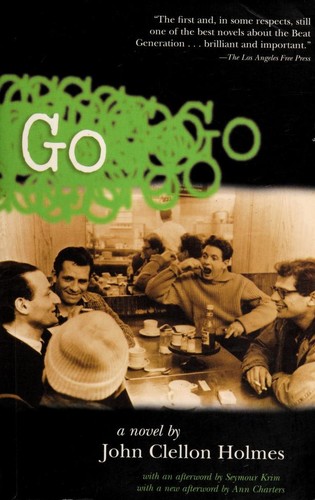
Go
A 1952 novel of restless young New Yorkers in the bebop era, and one of the first serious portraits of the Beat generation, written by a friend who lived it.
What It's About
Go follows a loose circle of young people in late-1940s New York as they drift between apartments, jazz clubs, parties, and bars, searching for something they can't quite name. Published in 1952, it is usually cited as one of the first novels to take the Beat generation seriously. Its author, John Clellon Holmes, knew the scene firsthand rather than watching it from outside, and that closeness gives the book its texture.
The structure is episodic and loose, closer to a sequence of scenes than a plot with a tidy arc. Holmes writes with a conversational intimacy, letting dialogue, overheard talk, and long stretches of reflection carry the momentum. Jazz shapes the rhythm of the prose as much as the subject matter, and the nights often blur together the way they do in memory.
Reading it feels less like following a story than like sitting in on conversations that run until dawn. Some passages are lush and some are repetitive, and the pacing can feel slack if you want events to escalate. What you get is a dated but vivid snapshot of a postwar generation trying to define itself against conformity, prosperity, and its own uncertainty.
Read this if you…
- want an early, firsthand look at the Beat generation before its legend took over
- like jazz-inflected prose and mood more than a tight plot
- are interested in postwar American restlessness and the search for meaning
Skip it if you…
- need a clear plot, strong momentum, or a satisfying resolution
- find self-consciously rebellious young men tiresome, which many readers do
Key Ideas
- 1
Restlessness as a way of life
The characters are not rebelling against a specific cause so much as refusing to settle. They sense that the security their elders fought for offers little meaning, and they keep moving in search of experience that feels real. The book treats this restlessness with sympathy but also lets you see its costs, including aimlessness and self-absorption.
- 2
Jazz as a model for prose
Holmes borrows the logic of bebop improvisation, with its repetitions, sudden shifts, and riffs on a theme. The sentences and scenes often seem to play off each other rather than advance in a straight line. If you enjoy writing that is attentive to rhythm and mood, this is one of the book's real pleasures.
- 3
Pressure to conform after the war
Jobs, marriage, and the promise of a comfortable life hover over the characters as expectations they half-want and half-resist. Holmes captures the ambivalence of people who can see the appeal of stability but cannot quite make themselves accept it. This tension gives the book much of its emotional charge.
- 4
Conversation as the main action
Much of what happens is talk: arguments about art, sex, religion, and what it means to be alive, carried on over drinks late into the night. The book makes conversation feel like the place where identity is tested. Readers who want dramatic events may find this slow, but it is the core of the reading experience.
- 5
A record of the Beat sensibility before the legend
Because the book appeared before the Beat movement became famous, it captures the ideas in an unpolished, almost tentative form. Reading it alongside later Beat writing shows how a set of attitudes took shape among friends. It works well as literary history as well as a novel.
Limitations
The plot is thin, and the episodic structure can feel shapeless, especially in the middle. The characters are mostly young men, and women often appear more as company than as fully realized people. Some of the talk about art, sex, and being hip reads as dated, and the mythmaking around the Beat generation can feel self-congratulatory. The book also offers little social critique beyond the disillusion of its own circle.
Questions Readers Ask
- Is Go a good place to start with the Beat writers?
- It can be, though it is less famous than On the Road and reads more like a document of a moment than a driving adventure. If you want a clear narrative, start with On the Road. If you want the atmosphere that produced that generation of writing, Go is a useful companion. Expect a slower, talkier book.
- Is Go still relevant today?
- Its portrait of young people searching for meaning outside conventional careers still resonates, but its attitudes toward women, race, and money reflect its era. Read it as literature and history rather than as a guide to living. Its jazz-influenced style remains striking and still feels fresh to many readers.
- Published
- 1952
- ISBN
- 9780911858341
- Difficulty
- intermediate
- Category
- Fiction
Book details and cover from Google Books.
Ready to read Go?
Get your copy on Amazon, or listen to it on Audible. We earn a commission if you buy through these links.