
We earn a commission if you buy through these links. Learn more
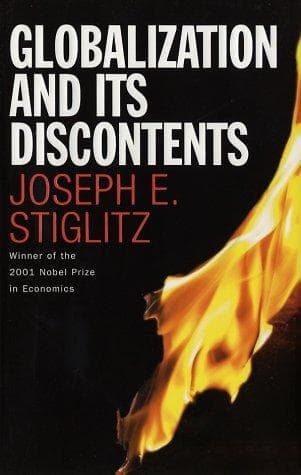
Globalization and its discontents
A Nobel economist's insider case that rushed market reforms and IMF bailouts often hurt the poor countries they were meant to rescue, written with real urgency.
What It's About
Joseph Stiglitz, a Nobel-winning economist who served as chief economist at the World Bank in the late 1990s, wrote this book in 2002 as an insider's critique of how international institutions, especially the International Monetary Fund, managed the spread of free markets to developing and transition economies. The category on this page says Tech, but this is economics and policy from start to finish.
Much of the argument rests on the East Asian financial crisis of 1997-98 and the post-Soviet transition in Russia. Stiglitz argues that rapid opening of capital markets, tight budgets, and one-size-fits-all loan conditions deepened recessions and served creditors and financial interests before ordinary citizens. He contrasts this with the view that markets depend on institutions, reliable information, and carefully ordered reforms, and that the people most affected rarely had a voice in the decisions.
The style is that of a clear, opinionated lecture rather than a dry textbook. Stiglitz uses few equations, explains ideas like information gaps in plain language, and writes with evident frustration at what he sees as a closed circle of officials and creditors. The reading experience is brisk and persuasive. It is one side of a serious debate, and that is part of its value.
Read this if you…
- want a critical insider account of how IMF and World Bank policy was made in the 1990s
- are interested in development economics or why poor countries struggle with financial crises
- prefer argument-driven nonfiction over technical models and data tables
Skip it if you…
- want a balanced survey of globalization's gains, since Stiglitz focuses mainly on its failures
- need current data on the global economy, since the book predates the 2008 crisis and later policy shifts
Key Ideas
- 1
Fast liberalization can make crises worse
Stiglitz's central claim is that opening financial markets quickly, before a country has the regulators and institutions to handle volatile money flows, can turn a manageable downturn into a collapse. He uses the Asian crisis to show how investor panic spread faster than governments could respond, and he argues that the policy advice of the time often ignored this sequencing problem.
- 2
Markets need guardrails because information is uneven
Much of his economic reasoning comes from information economics. Lenders, investors, and borrowers rarely know the same things, and markets do not automatically correct for that. Stiglitz uses this idea to argue that governments have a legitimate role in regulation and that assuming efficient markets by default leads to bad policy in countries with weak institutions.
- 3
The IMF's standard prescriptions under scrutiny
He criticizes the pattern of attaching austerity, rapid privatization, and fiscal cuts to emergency loans, arguing that these conditions were applied with too little knowledge of local conditions. He suggests that the fund's priorities leaned toward protecting foreign creditors and keeping financial institutions whole, while workers and the poor absorbed much of the cost.
- 4
Who decides how globalization works
A recurring theme is the lack of democratic accountability in international economic institutions. Decisions were often made by a small group of officials in Washington with limited transparency, and poorer countries had little meaningful say. Stiglitz argues that globalization will only be seen as legitimate if the people it affects can shape its rules.
Limitations
The book was written in 2002, so its case studies and policy debates reflect that moment. The IMF and other institutions have since changed some positions, including on capital controls, and later crises have added new evidence. Critics, including trade economists such as Jagdish Bhagwati, argue that Stiglitz underplays the benefits of openness and sometimes blames institutions for outcomes shaped by domestic governments. The book is also one-sided by design, so readers should treat it as a strong argument rather than a neutral verdict.
Questions Readers Ask
- Is Globalization and Its Discontents still relevant?
- Yes, especially for understanding debates about financial crises, austerity, and the role of international institutions. However, the specific events and some policy positions date from 2002. Readers should pair it with more recent analysis, particularly on the 2008 crisis and the IMF's later revisions to its thinking on capital flows.
- How does it compare to Jagdish Bhagwati's In Defense of Globalization?
- They are often read as opposing views. Stiglitz focuses on how institutions and policy choices have caused harm, while Bhagwati defends the economic gains from trade and openness and places more blame on poor implementation. Reading both gives a fuller picture than either one provides alone.
- Do I need an economics background to read it?
- No. Stiglitz writes for general readers and explains concepts in plain language with few equations. Some familiarity with basic economics, such as inflation, exchange rates, and public budgets, will help, but the book is more about political judgment and policy argument than technical detail.
- Published
- 2002
- ISBN
- 9780393051247
- Difficulty
- intermediate
- Category
- Tech
Book details and cover from Google Books.
Ready to read Globalization and its discontents?
Get your copy on Amazon, or listen to it on Audible. We earn a commission if you buy through these links.