
We earn a commission if you buy through these links. Learn more
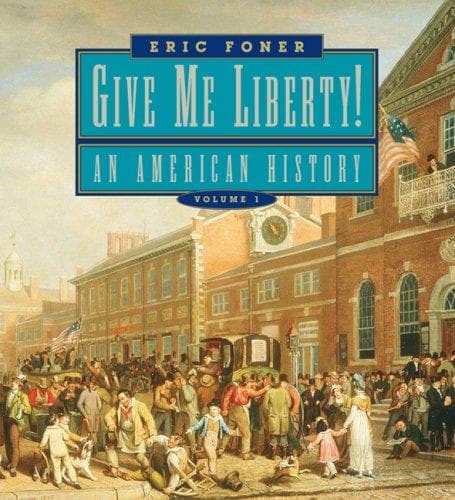
Give Me Liberty!
by Eric Foner
Foner's one-volume survey treats American freedom as a contested idea, making a long, sprawling history easier to follow and argue with.
What It's About
Give Me Liberty! is a one-volume survey of American history written as a college textbook, though it reads more coherently than most. Foner organizes the story around one question: how the meaning and reach of freedom expanded, narrowed, and was fought over from colonial times to the present. Coverage is broad, spanning politics, economics, slavery, labor, westward expansion, and foreign policy, with social and cultural history woven in rather than added as an afterthought.
The writing is clear and measured, and the narrative is carried by argument rather than by names and dates alone. Foner makes the case that American freedom has always been contested, with each expansion, from the Revolution through the civil rights era, provoking efforts to limit it. Chapters move through major turning points with attention to ordinary people, including enslaved men and women, workers, women, and immigrants, not only presidents and generals. Maps, illustrations, and feature boxes on documents and historical debates support the text.
Reading it feels like being walked through a long, orderly lecture series by a historian who knows the field deeply and rarely hides his judgments. It works best read straight through or alongside a course. It is less a quick overview than a sustained argument, and readers who want a single narrative thread will find it rewards patience.
Read this if you…
- want a single, coherent account of American history rather than a collection of isolated episodes
- are willing to read a dense textbook carefully and think about its central argument
- want to understand how fights over race, labor, and rights connect across different eras
Skip it if you…
- want a light, narrative-driven popular history with vivid storytelling and few dates or names
- need a quick overview of a specific period or topic rather than the full sweep of the nation's past
Key Ideas
- 1
Freedom as a contested idea
Foner treats liberty not as a fixed inheritance but as a concept that different groups defined in conflicting ways. Who counted as free, and what freedom meant in practice, becomes the lens through which politics, law, and social conflict are read across the book.
- 2
Expansion followed by backlash
Many chapters trace a pattern in which a widening of rights, such as after the Revolution, Reconstruction, or the New Deal, provoked resistance that narrowed it again. The book uses this cycle to explain why progress in American history has so often been uneven and reversible.
- 3
Slavery and race at the center
Rather than treating slavery and its aftermath as a regional side story, the book places them at the core of national development. Politics, economic growth, and constitutional disputes are shown as tied to the question of who could be owned, enslaved, or fully included.
- 4
Ordinary people as makers of history
Workers, women, enslaved people, and immigrants appear as active participants who shaped outcomes, not just as background. This approach gives the survey a social depth that many older textbooks, focused on leaders and institutions, lack.
Limitations
Some critics argue that organizing the story around freedom can make the history read as a progressive arc, smoothing over conflicts that do not fit that frame. As a survey, the book compresses many episodes, so specialists will find thin treatment of some regions, religious movements, and foreign relations. Its coverage is updated across editions, but a reader using an older printing will miss newer scholarship and more recent events.
Questions Readers Ask
- Is Give Me Liberty! a textbook or a book for general readers?
- It was written as a college survey, but it is readable by any adult with an interest in American history. No prior background is needed. Expect a dense, detailed narrative with many names and dates, so it rewards slow reading more than casual skimming.
- How does it compare with Howard Zinn's A People's History of the United States?
- Zinn's book is openly polemical and organized around the perspective of those excluded from power. Foner is more conventional in structure and tone, presenting a survey with a central argument about freedom while still giving attention to workers, enslaved people, and other groups. Readers wanting a sharper critique may prefer Zinn; readers wanting a balanced survey may prefer Foner.
- Is it still useful for understanding current American politics?
- Yes, its framework of contested rights and recurring backlash remains useful for thinking about current debates. For the most recent decades, though, check the edition date and supplement the book with current reporting and newer scholarship.
- Published
- 2004
- ISBN
- 9780393978742
- Difficulty
- intermediate
- Category
- History
Book details and cover from Google Books.
Ready to read Give Me Liberty!?
Get your copy on Amazon, or listen to it on Audible. We earn a commission if you buy through these links.