
We earn a commission if you buy through these links. Learn more
Ghost boys
Guide by the Books of the Day editors · Updated · How we write our guides
A short, unflinching middle-grade novel that tells a police shooting from the victim's afterlife, asking who answers for a Black boy's death and who remembers him.
What Creators Say About Ghost boys
2 creators reviewed Ghost boys on YouTube between 2018 and 2019, with 50.3K views between them. Their opinions are their own; we picked these reviews, we didn't write them.
What It's About
Ghost Boys is a middle-grade novel, written for roughly ages 10 and up, that opens with twelve-year-old Jerome being shot dead by a police officer who mistakes the toy gun he is carrying for a real weapon. Jewell Parker Rhodes does not stop at the shooting. She follows Jerome into an in-between existence where he can watch his family, his school friends, and the officer's household as they absorb what happened.
Jerome's guide is Emmett Till, the fourteen-year-old lynched in Mississippi in 1955, who appears as a ghost to help him make sense of his death. Their conversations move between 1955 and present-day Chicago, placing one shooting inside a longer history of Black boys killed for ordinary, childish acts. The prose is short and direct, the chapters shift point of view, and the weight comes from watching the aftermath rather than from action or suspense.
Reading it feels like sitting with grief. It is brief enough to finish in an afternoon, but it lingers. Rhodes writes for young readers and adults alike, and the experience is less a thriller than a reflective account of accountability, memory, and what a community is left carrying after violence.
Read this if you…
- want a short, emotionally direct novel about racism and policing that works for teen readers and adults
- are interested in how fiction can connect a present-day injustice to a longer historical pattern
- can handle a story about a child's death and want to sit with its aftermath rather than be shielded from it
Skip it if you…
- want a plot-driven story with suspense, twists, or a clear mystery to solve
- are looking for a nuanced, adult-level portrait of policing and its institutional politics
Key Ideas
- 1
A child's death seen from outside
Because Jerome is dead for most of the story, the reader sees the shooting's consequences through the eyes of someone who cannot act. The helplessness is deliberate. It forces you to watch grief, rumor, and institutional defensiveness unfold without the comfort of a rescue plot.
- 2
Emmett Till as a bridge to history
Rhodes uses Emmett Till's presence to connect a modern police killing with the racial violence of the Jim Crow era. The point is not a neat comparison but a reminder that the same pattern of a Black boy's life being treated as disposable has a long record in America.
- 3
Who is held responsible
The book keeps asking who bears responsibility when a child dies in a confrontation that should never have happened. It looks at individual choices, but also at fear, training, and the stories adults tell about which children seem dangerous, without offering easy villains or easy absolution.
- 4
Memory and the work of remembering
A large part of the book concerns who gets remembered and how. Jerome's ghostly vantage shows how the people closest to him try to keep his name and his humanity intact against media narratives that reduce him to a single moment.
Limitations
Critics sometimes say the book is more an argument than a story. Its characters can feel like vehicles for its message, and the ghostly framing, while moving, asks readers to accept a lot of emotional clarity in a short space. Some find the portrayal of the police officer and his family underdeveloped compared with Jerome's world. The novel also explores a single shooting in a fairly bounded setting, so it does not attempt a broad survey of policing or of the wider debate about police violence. Those looking for systemic analysis will need other sources.
Questions Readers Ask
- Is Ghost Boys suitable for adult readers or only children?
- It is written as middle-grade fiction, but many adults read it and find it powerful. The sentences are simple and the chapters short, so the reading level is accessible. Adults may find it more affecting as a conversation starter than as a sophisticated literary novel, and it works well read alongside a younger reader.
- How does Ghost Boys compare to The Hate U Give?
- Both address police violence against a Black teenager, but The Hate U Give is a longer young adult novel centered on a living protagonist testifying in her community's response. Ghost Boys is shorter and more lyrical, told from beyond death, and it leans harder on history and memory. Readers wanting a fuller social world may prefer the first.
- Published
- 2014
- ISBN
- 9781432873738
- Difficulty
- beginner
- Category
- Fiction
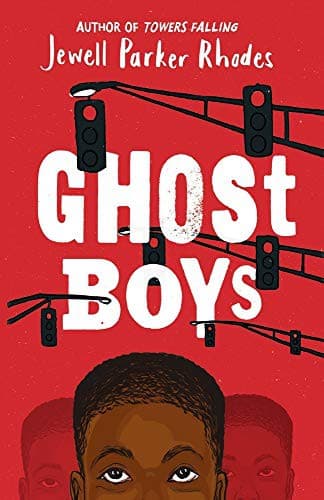
Book details and cover from Google Books.
Ready to read Ghost boys?
Get your copy on Amazon, or listen to it on Audible. We earn a commission if you buy through these links.