
We earn a commission if you buy through these links. Learn more
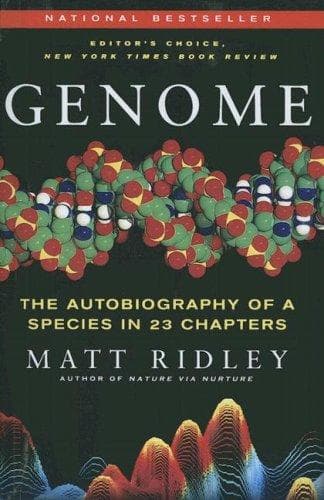
Genome
by Matt Ridley
Guide by the Books of the Day editors · Updated · How we write our guides
Ridley uses the 23 pairs of human chromosomes as a guide through genetics, making a persuasive case that genes are a responsive record of our history rather than a fixed script for our lives.
What Creators Say About Genome
2 creators reviewed Genome on YouTube between 2015 and 2023, with 7K views between them. Their opinions are their own; we picked these reviews, we didn't write them.
What It's About
Genome is a tour of the human genetic code that uses the 23 pairs of chromosomes as its organizing device, moving through them one at a time. Each stop pairs a chromosome with a theme such as disease, behavior, intelligence, or the history of our species, so the book reads more like a set of linked essays than a textbook. Ridley is a science writer, and his prose is brisk and argumentative.
The experience is like being walked through a map by a guide who has strong opinions. He draws on research from the late 1990s, explains in plain language how genes are read and how they interact with environment, and keeps returning to one central point: the genome is not a blueprint of fixed destiny. Expect many human stories and well-chosen examples rather than heavy equations.
Because it was written before the draft sequence of the human genome was finished and before much of today's work on gene regulation and epigenetics, its specific facts are dated. Its lasting value lies in the framing and the argument, which still hold up well for general readers.
Read this if you…
- Want a readable overview of how the genome works without needing a biology degree
- Are curious about the nature-nurture debate and want it framed by a science writer
- Enjoy popular science with strong opinions and vivid human stories
Skip it if you…
- Want an up-to-date account of the sequenced human genome or modern gene editing
- Prefer a rigorous, citation-heavy text or dislike a writer who argues hard for his view
Key Ideas
- 1
Genes are not destiny
Ridley pushes back against the idea that a single gene locks in a trait or a fate. He shows how genes respond to surroundings and how the same genetic material can produce very different outcomes. The result is a more hopeful and more complicated picture of inheritance than many popular accounts offer.
- 2
The genome as a history book
Much of the genetic code is a record of past events, including duplicated sequences, remnants of ancient viruses, and shared inheritance with other species. Reading the genome this way turns it into a story of how our species came to be. Ridley uses this idea to connect molecular detail with evolutionary change.
- 3
Nature and nurture as partners
The old argument over whether nature or nurture wins is presented as a false choice. Ridley argues that genes are what make learning and adaptation possible in the first place. This framing gives the book one of its most useful lenses for thinking about behavior and intelligence.
- 4
Inherited disease and its complications
Ridley uses examples of inherited illness to show how a clear genetic cause can still lead to messy, variable outcomes. These cases reveal why medical genetics is harder than early optimism suggested. Readers get a sense of where the science was headed and where it stalled.
Limitations
The book is dated. It was written before the human genome was fully sequenced, and some of its estimates, including figures for gene counts and links between specific genes and traits, have since been revised. Later work on gene regulation, epigenetics, and genetic editing is absent. Some critics also feel the chromosome-by-chromosome structure forces a loose narrative, and that Ridley's confident tone sometimes outruns the evidence of the period.
Questions Readers Ask
- Do I need a biology background to read Genome?
- No. Ridley explains the basic mechanics of DNA, genes, and chromosomes in plain language and avoids most technical jargon. Some passages on molecular detail can feel dense, but you can follow the main arguments without prior training. A curious general reader should find it accessible.
- Is Genome still accurate today?
- Partly. Its broad framing about genes, environment, and evolution still holds up well. Specific facts, gene counts, and disease associations have moved on since the late 1990s. Treat it as a strong guide to the ideas and debates of its era, and check newer sources for current science.
- Published
- 1999
- ISBN
- 9781417639922
- Difficulty
- intermediate
- Category
- Tech
Book details and cover from Google Books.
Ready to read Genome?
Get your copy on Amazon, or listen to it on Audible. We earn a commission if you buy through these links.