
We earn a commission if you buy through these links. Learn more
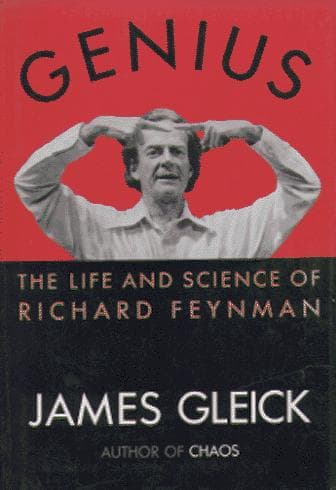
Genius
by James Gleick
A readable, humane portrait of Richard Feynman that explains his life and physics in plain language, so you can understand why his way of thinking still matters.
What It's About
Genius is James Gleick's biography of Richard Feynman, the Nobel-winning physicist who became one of the most recognizable scientists of the twentieth century. Rather than a dry chronicle of appointments and publications, Gleick follows Feynman from a boyhood in Far Rockaway, Queens, through wartime work at Los Alamos, to his later years at Caltech, and he keeps asking what made Feynman's way of thinking different.
The approach is narrative first, science second. Gleick explains physics in everyday language, using analogies and concrete examples, so a reader without a math background can follow the broad shape of Feynman's work on quantum electrodynamics and his path-integral ideas without needing the equations. The tone is brisk and anecdotal, drawing on Feynman's own stories, interviews, and the memories of colleagues, and Gleick weighs those accounts against other sources rather than simply repeating them.
The book is also a portrait of a personality: the playful problem-solver who cracked safes and drummed on bongos, the teacher who loved explaining things to undergraduates, and the more serious figure who later took on the Challenger investigation. Gleick pays attention to Feynman's marriages and losses, but the emphasis stays on work and character. The result is entertaining and humane, and it tends to leave readers wanting to pick up Feynman's own writing next.
Read this if you…
- want an accessible introduction to modern physics through the life of one of its most colorful practitioners
- are curious how a scientist's personality and habits shape the work they produce
- enjoy biographies that balance storytelling with real explanation of ideas
Skip it if you…
- want a technical account of quantum electrodynamics or the mathematics behind Feynman's methods
- are looking for a detailed private life or a full family history, since the focus stays on work and character
Key Ideas
- 1
Curiosity as a working method
Feynman's defining habit was to rederive things for himself rather than accept a result because an authority stated it. Gleick shows how this stubborn independence shaped his choices of problems, his impatience with received wisdom, and his willingness to chase questions that other physicists had dismissed as unproductive or too odd to bother with.
- 2
Rethinking physics through pictures and sums
Feynman invented ways of visualizing particle interactions, most famously the diagrams that bear his name, and a method that adds up all the possible paths a particle can take. Gleick explains why these tools were so powerful: they made hard calculations manageable and gave physicists an intuitive handle on phenomena that had resisted older formalisms.
- 3
Teaching as a test of understanding
For Feynman, if an idea could not be explained clearly to a student, the speaker probably did not understand it. The book shows how his lecturing, his Caltech teaching, and his popular writing were not side projects but part of how he worked out his own thinking, and why he treated clarity as a discipline.
- 4
Integrity under institutional pressure
Gleick's account of the Challenger inquiry shows Feynman refusing to accept official explanations that did not match the evidence. His dramatic demonstration with a piece of O-ring material and ice water is presented as an example of a scientist insisting on checkable facts over bureaucratic comfort, and of the personal cost that sometimes came with that stance.
Limitations
Gleick's book is from 1992, so it predates the later publication of many Feynman letters and papers, and some of its material reflects the biographer's choices among sources. Feynman's own anecdotes are famously polished, and a reader should keep in mind that some stories are better told than documented. The science is simplified by design, so readers wanting rigorous detail will need textbooks or Feynman's lectures. Some readers also find the book's admiration for its subject leaves little room for his less admirable traits.
Questions Readers Ask
- Do I need a physics background to enjoy Genius?
- No. Gleick writes for general readers and explains the central ideas without equations. You will get a clear sense of what Feynman contributed and why it mattered. A basic interest in science and some patience with unfamiliar concepts are enough. Readers with a physics background will find more to appreciate in how accurately the ideas are conveyed.
- How does Genius compare with Feynman's own books?
- Feynman's memoirs and lectures are in his own voice, full of first-hand stories and direct explanations. Gleick offers an outside view that places those stories in context and tracks his career across decades. Reading the biography first can make Feynman's own books more rewarding, and reading them afterward can show where Gleick's account is strongest.
- Published
- 1992
- ISBN
- 9780679747048
- Difficulty
- intermediate
- Category
- Science
Book details and cover from Google Books.
Ready to read Genius?
Get your copy on Amazon, or listen to it on Audible. We earn a commission if you buy through these links.