
We earn a commission if you buy through these links. Learn more
Front Desk
by Kelly Yang
Guide by the Books of the Day editors · Updated · How we write our guides
A warm, funny, and sharp middle-grade novel about a ten-year-old immigrant girl who runs a struggling motel front desk while learning how fairness and courage actually work.
What Creators Say About Front Desk
2 creators reviewed Front Desk on YouTube between 2018 and 2019, with 25.7K views between them. Their opinions are their own; we picked these reviews, we didn't write them.
What It's About
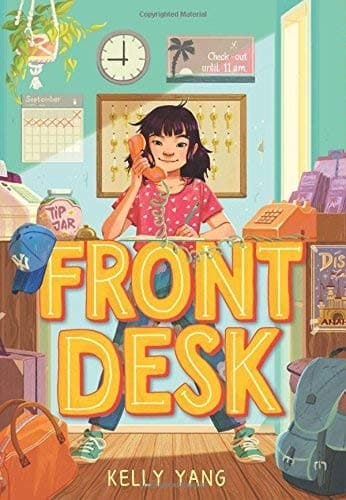
Front Desk is a middle-grade novel by Kelly Yang, published in 2018, about Mia Tang, a Chinese American ten-year-old whose family has moved to California to run a rundown motel. Her parents work long hours, so Mia spends much of her time at the front desk, handling guests, phone calls, and the motel's owner, a demanding man who is quick to criticize and slow to pay.
The story is told in Mia's first-person voice. The prose is plain and quick, with short scenes, everyday comedy, and a narrator who notices far more about adults than they expect. That lightness sits alongside real hardship: money worries, the strain of translating for family, school troubles, and the constant question of who gets treated decently and who does not. Yang explains these pressures through Mia's eyes rather than through lectures.
Reading it feels like sitting with a kid who is braver and more observant than the adults around her. It is emotionally direct, and several scenes are built to make you angry on Mia's behalf. Readers of any age should expect to be moved, and the book works especially well as something to read alongside a child and talk about afterward.
Read this if you…
- want a middle-grade story about immigrant family life that does not shy away from hardship
- are looking for a fast, emotionally honest read to share with a child or a classroom
- enjoy a narrator with a strong, funny voice who notices injustice and speaks up about it
Skip it if you…
- want a fast-paced plot built around a mystery, quest, or big action set pieces
- prefer fantasy, science fiction, or stories with a lot of invented worlds
Key Ideas
- 1
Dignity in ordinary, underpaid work
The front desk becomes a window onto how power works in everyday service jobs. Mia learns quickly who is respected, who is ignored, and how a small business can depend on people who have little leverage. The book treats work as something that shapes a family's sense of worth, not just a source of income.
- 2
Language as both burden and tool
Mia often stands between her parents and English-speaking adults, which gives her responsibilities far beyond her years. The book shows translation as a kind of power that can protect people or leave a child carrying adult stakes. It asks what it costs a kid to be the family's interpreter.
- 3
Courage in small, careful acts
Mia's bravery rarely looks like a dramatic confrontation. It shows up as persistence, honesty, and refusing to accept unfair treatment quietly. The story suggests that standing up for yourself can be practical and patient rather than reckless.
- 4
Money pressure shaping every decision
The family's finances hang over nearly every scene, influencing what they can say, what they can risk, and how they see their future. Yang keeps this concrete and specific, so younger readers can grasp economic anxiety without it being turned into an abstract lesson.
- 5
Writing as a way to be heard
Mia discovers that putting her thoughts into words can change how others see her and her family. The theme of voice runs through the book, showing that being overlooked and being unheard are not the same thing, and that a child's perspective deserves attention.
Limitations
The book is brief, and some of its problems are resolved more neatly than real life usually allows. Several adult characters are drawn in broad strokes, and the owner in particular is sketched as a clear villain, which some readers find heavy-handed. The story also reflects one family's experience in one place, so it is not a survey of immigrant life in general. Some readers may find the emotional beats forceful, though many young readers respond to that directness.
Questions Readers Ask
- Who is Front Desk best suited for?
- It suits readers roughly eight to twelve, and adults who want to read it with a child. It also works well in classrooms because it opens conversations about work, language, fairness, and immigrant experience. Older readers who enjoy a quick, character-driven novel will likely find it rewarding too, though the plot is simple and the emotional tone is direct.
- How does it compare to other immigrant stories for young readers?
- Front Desk is more plot-driven and workplace-focused than many books in this area. If you liked Inside Out and Back Again by Thanhha Lai, you will recognize the attention to a child's perspective on family struggle, though Yang's book leans more on the motel setting and the pressure of an unfair employer.
- Is the book still relevant today?
- Yes. Its themes of immigrant labor, language brokering, and fairness in small businesses remain very current. Some period details reflect the late 2010s, but the core situation and Mia's emotional journey feel timeless enough that the book still speaks clearly to new readers.
- Published
- 2018
- ISBN
- 9781536456202
- Difficulty
- beginner
- Category
- Children's Books
Book details and cover from Google Books.
Ready to read Front Desk?
Get your copy on Amazon, or listen to it on Audible. We earn a commission if you buy through these links.