
We earn a commission if you buy through these links. Learn more
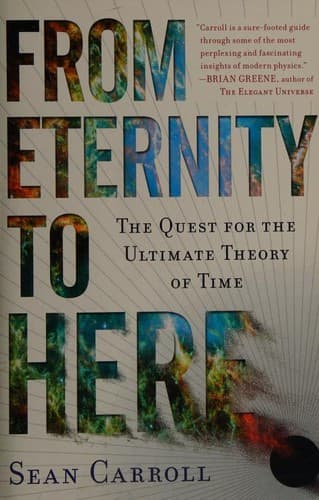
From eternity to here
Guide by the Books of the Day editors · Updated · How we write our guides
A working physicist's clear, honest look at why time runs forward, why the past feels different from the future, and what that asymmetry says about the universe's origins.
What Creators Say About From eternity to here
2 creators reviewed From eternity to here on YouTube in 2026, with 41 views between them. Their opinions are their own; we picked these reviews, we didn't write them.
What It's About
Despite its listing under fiction, From Eternity to Here is nonfiction: a physicist's attempt to explain one of the strangest facts about the universe. Most fundamental physical laws work the same forward and backward, yet we experience time as a one-way street, remembering the past and never the future. Carroll takes that asymmetry seriously and traces it to entropy and to the unusual conditions of the universe's early history.
The book moves through the ideas that built the puzzle, from nineteenth-century thermodynamics to Boltzmann's statistical reasoning, and then into modern cosmology, where the question of why the early universe was so ordered remains open. Carroll is candid about which ideas are established and which are speculative. He offers his own bold proposal about how our universe might sit inside a larger cosmic picture, and he keeps returning to what it would mean to know anything about the past at all.
The experience is that of a patient, conversational lecture rather than a textbook. Equations appear sparingly and mostly in prose, but you will need to follow careful arguments and test thought experiments for hidden assumptions. It rewards slow reading, and you should finish with a sharper sense of why the question matters even if no single answer feels final.
Read this if you…
- are curious about why time has a direction, even if you have never studied physics
- enjoy popular science that openly wrestles with unsolved questions rather than presenting settled facts
- want a plain-language grounding in entropy and cosmology before moving on to harder texts
Skip it if you…
- want a concise summary or a practical guide, since this book is long, discursive, and driven by argument
- need a settled textbook treatment, because much of the later material is speculative and presented as such
Key Ideas
- 1
Why time seems to have a direction
The basic laws of physics barely distinguish past from future, so the one-way feel of time needs a separate explanation. Carroll frames this as the central puzzle and shows why it is harder than it first appears. He makes clear that the answer must come from how the universe is arranged, not from the equations alone.
- 2
Entropy as the engine of the arrow
Entropy is a measure of how many microscopic arrangements match what we observe, and it tends to grow. Carroll explains how this statistical idea, rather than any rule that forbids reversal, makes certain processes overwhelmingly likely. The explanation is clear enough that a patient reader can follow it without advanced mathematics.
- 3
The puzzle of the low-entropy beginning
If entropy only grows, the universe must have started in a remarkably ordered state. Carroll argues this is the real mystery behind time's direction. The question of why the beginning was so special is one of the book's most important threads, and it is still unresolved among physicists.
- 4
Memory, knowledge, and the cosmic perspective
Our sense of the past depends on records that exist only because of the same entropy gradient. Carroll pushes this line of thought toward skepticism about what we can know about the distant past. It is a thought-provoking shift from physics into the theory of knowledge.
Limitations
Carroll's own model is one contested proposal among several, and readers should not treat it as the consensus view. Some sections, especially the discussion of a larger cosmic setting, go further into speculation than the general reader may expect. Cosmology has advanced since the book appeared in 2010, so observational details and some of the open questions have moved on. The middle chapters can also feel repetitive to readers who grasp the core argument early.
Questions Readers Ask
- Is From Eternity to Here fiction or nonfiction?
- It is nonfiction, even though some listings place it in fiction. It is a popular science book by a theoretical physicist, written for general readers, about the arrow of time, entropy, and the early universe.
- Is the book still worth reading today?
- Yes, if you want to understand the questions rather than the latest data. The puzzle of why time has a direction remains open, and Carroll's framing of it is still useful. Pair it with newer cosmology writing for current observational detail.
- Published
- 2009
- ISBN
- 9781851687954
- Difficulty
- intermediate
- Category
- Fiction
Book details and cover from Google Books.
Ready to read From eternity to here?
Get your copy on Amazon, or listen to it on Audible. We earn a commission if you buy through these links.