
We earn a commission if you buy through these links. Learn more
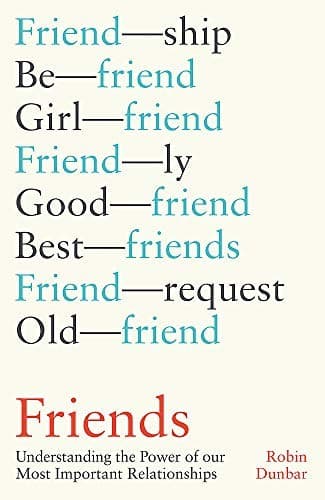
Friends
by Robin Dunbar
Dunbar's accessible case that friendship is a biological necessity as well as a social pleasure, with layers and upkeep costs worth understanding.
What It's About
Friends is Robin Dunbar's attempt to explain why friendship matters so much to human health and happiness, and how it works as a biological as well as a social phenomenon. Dunbar, an evolutionary psychologist, builds on his earlier work on brain size and group size to argue that our friendships are structured in layers: a small inner circle of intimate ties, larger groups of people we see less often, and a wide outer ring of acquaintances. The book draws on research into the effects of isolation, the role of touch and shared laughter, and the chemistry of social bonding.
The writing is conversational and mostly plain. Dunbar moves between accessible science, examples from studies and everyday life, and practical reflection on how people keep friends across life stages. He is clear that friendship is not automatic. It takes time, repeated contact, and a willingness to show up, and he spends real attention on how these demands change from school years to midlife to old age. He also discusses how men and women tend to form friendships differently.
Reading it feels less like a self-help manual and more like talking with a researcher who is enthusiastic about his subject and happy to show the reasoning behind his claims. You will come away with a clearer picture of why certain friendships fade and what it takes to keep the important ones alive.
Read this if you…
- want a research-based explanation of why friendships matter for health and wellbeing
- are curious about the evolutionary roots of social life and why humans have limited social capacity
- feel your friendships have drifted and want to understand why keeping ties alive takes deliberate effort
Skip it if you…
- want a step-by-step guide with exercises for making new friends
- prefer dense academic writing with full methodological detail and statistical analysis
Key Ideas
- 1
Friendship is organised in layers
Dunbar describes a series of rough circles around each person, from a handful of very close friends through larger groups of people we know less well. Each layer tends to be bigger and more loosely held than the one inside it. The model helps explain why we can have many contacts but only a few people we would call on in a crisis.
- 2
Friendships require ongoing investment
A central argument is that friendship is maintained by time and attention rather than by good intentions. Relationships that are not regularly renewed tend to drift into a lower layer, even if both people still like each other. This makes friendship feel more like a practice than a feeling, and it explains why moving or changing jobs can quietly reshape a social life.
- 3
Bonding is tied to body chemistry
Dunbar examines how shared laughter, touch, music, meals and synchronised activity seem to support bonding, and he discusses the idea that natural opioids play a role. The strength of this evidence varies, and some of it comes from animal research. Still, the chapters make a persuasive case that friendship is physical as well as mental.
- 4
Friendship changes across the life course
The book follows how friendships are formed and sustained in childhood, adolescence, early adulthood, midlife and later life. Each stage brings different opportunities and obstacles, such as school, work, children or loss. Readers may recognise their own history in these shifts and find a useful frame for why some connections faded naturally.
- 5
Men and women build friendship differently
Dunbar discusses a common contrast in which many women form close ties through face-to-face conversation, while many men bond more through shared activities done side by side. He treats these as tendencies rather than rules. The discussion helps explain why friendship can look different across genders and why some men struggle to find close confidants.
Limitations
Some reviewers find the book repeats its central ideas and leans on a few well-known findings. The more popular passages can simplify research that is still debated. The 150-person figure is sometimes presented as a firm limit, while critics argue the evidence is looser and that network size varies widely between people and cultures. Much of the biological material relies on animal studies and small human studies, so treat the mechanism claims as plausible rather than settled. Practical advice on starting new friendships is limited.
Questions Readers Ask
- Is Friends worth reading if I already know Dunbar's number?
- Partly. The book is the fuller popular account of the layered model and the reasons behind it, so it adds real depth. If you have only read summaries of the 150 idea, expect some familiar points, along with more detail on the biology and on life-stage changes in friendship.
- How does it compare to Dunbar's earlier book on group size?
- Friends is broader and more personal in tone, with more attention to how people maintain friendships in everyday life. His earlier book focuses more on the evolutionary puzzle of group size. If you want the big theoretical picture, start with the earlier book. If you want practical implications, Friends is the better choice.
- Is the book still relevant given how much friendship now happens online?
- The core research on time, shared experience and friendship maintenance has aged well. The discussion of digital contact is less developed than the debate that has followed since publication, so readers interested in online friendship may want to supplement it with more recent work.
- Published
- 2021
- ISBN
- 9780349143576
- Difficulty
- beginner
- Category
- Psychology
Book details and cover from Google Books.
Ready to read Friends?
Get your copy on Amazon, or listen to it on Audible. We earn a commission if you buy through these links.