
We earn a commission if you buy through these links. Learn more
Friday night lights
A raw, unsentimental look at high school football as the engine of a small Texas town, and at the adults and teenagers who carry its hopes and its pressure.
What It's About
Friday Night Lights follows the Permian High School Panthers football team in Odessa, Texas, through the 1988 season. Bissinger, a journalist who spent that year reporting from inside the program, wrote the book as reportage rather than a memoir or a sports diary. The games matter, but the book keeps returning to what surrounds them: coaches who treat the season as a referendum on their careers, boys who carry the town's expectations on their shoulders, and families who see a scholarship as the way out.
The style is blunt and unsentimental. Bissinger moves between practice fields, locker rooms, booster meetings, and kitchen tables, building a portrait of a city whose economy had been battered by the oil bust and whose sense of itself was tied to Friday night. He does not rush toward a tidy moral, and he is willing to show ugly behavior from adults and teenagers alike. The prose is fast and vivid, and the detail is dense enough that you feel you have spent a season in the stands.
Reading it is less like following a sports story and more like sitting with a community under strain. It is emotionally heavy, sometimes angry, and often uncomfortable, and that discomfort is much of its power. Expect a book about pressure, class, and race as much as about football.
Read this if you…
- want an unflinching look at how high school sports can shape an entire community
- are interested in journalism about class, race, and economic decline in small American cities
- liked the film or TV series and want to read the book it was based on
Skip it if you…
- want an inspirational sports story with a clean, triumphant arc
- are put off by harsh language, drinking, and frank depictions of cruelty among teenagers
Key Ideas
- 1
Football as the town's organizing identity
Bissinger shows how a high school team becomes public civic life in Odessa, shaping local pride, business, and social standing. Winning becomes a way for a struggling community to feel like it still counts, which is why losing feels so personal to everyone involved.
- 2
The weight placed on teenagers
The players are asked to carry adult ambitions about glory, money, and identity long before they have the tools to handle them. The book pays close attention to what this does to their bodies, their judgment, and their sense of who they are if the dream fails.
- 3
Coaching as a high-stakes gamble
The head coach's job, reputation, and family life depend on results, and the book examines how that pressure bends his decisions and his relationships. It treats the coach as a deeply human figure rather than a simple villain or hero.
- 4
Class and race beneath the Friday night surface
Community unity on game night hides real divisions of money, neighborhood, and race. Bissinger uses the team to show who gets opportunity and who is expected to supply the effort, without turning the book into a lecture.
- 5
Reporting that refuses easy heroes
The narrative method is immersive and selective, drawing on close access to many voices. Its distinctive quality is a refusal to flatter either the town or the athletes, which makes the story feel more honest and more unsettling than a typical sports book.
Limitations
Critics, including some people from Odessa, have argued that the book leans on the bleakest parts of the town and presents the community through an outsider's eyes. Its focus is one school and one season in 1988, so it says little about football in general or about Texas high school sports today. The economic and social context is specific to a particular moment, and the book is more a snapshot than a current account. Its language and candid content may also be a barrier for some readers or younger teens.
Questions Readers Ask
- Is Friday Night Lights still relevant today?
- Yes, mainly because its subjects are timeless: adolescent pressure, the economics of small towns, and the way communities invest meaning in youth sports. Some details reflect the late 1980s, including the oil economy and the era's attitudes, so read it partly as a historical document. The core human story still lands strongly.
- How does the book compare to the TV series?
- The book is nonfiction reportage about one real season, while the NBC series is a fictionalized drama that moves the story to a different setting and invents characters and storylines. The book is harsher and more journalistic, with less of the family-drama focus that made the show popular. Many readers find they appreciate the two more after experiencing both.
- Is it appropriate for teenagers to read?
- It depends on the reader. The book includes profanity, drinking, violence, and frank discussion of sex and cruelty, so it is generally better suited to older teens and adults. Parents of younger readers may want to read it first, especially given its serious themes about pressure and mental health.
- Published
- 1990
- ISBN
- 9780306815294
- Difficulty
- beginner
- Category
- Education
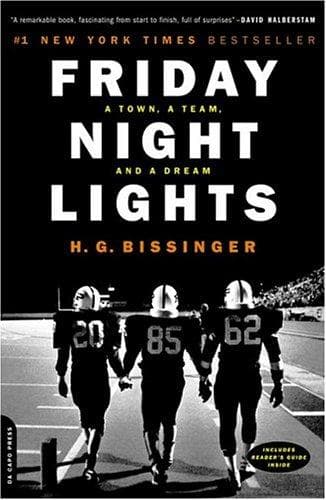
Book details and cover from Google Books.
Ready to read Friday night lights?
Get your copy on Amazon, or listen to it on Audible. We earn a commission if you buy through these links.